All content on this blog is copyright by Marci Andrews Wahlquist as of its date of publication.

Saturday, January 27, 2018

Jessie Jane on Her Own Terms

This is a biography of one of my great aunts, colored by my imagination.


Jessie Jane Munro was born over in Oklahoma Territory, or maybe it was the State, she wasn’t sure ever afterwards. A strip of land along Oklahoma’s northern border had been sold by the Cherokee Nation to the United States Government for a price that of course was a steal on the part of the United States (and they didn’t even pay up until 1964). Jessie’s parents had joined a hundred thousand other folks charging into the territory on September 16, 1893.

The Munro family had come over from Arkansas on the east, and, not interested in staking a big land claim, Jessie’s daddy intended to open a cabinet and wood-finishing business in the little town of Newkirk, already laid out before the land rush began. He had learned the woodworking trade up north, in Wisconsin, and had come south to Arkansas when work turned scarce back home, but he hadn’t been finding things easy. There was also that little matter of his having deserted from the U.S. Army. He had to stay a step ahead of that thing.

Jessie’s mama had just discovered that she was expecting another little one when they had come over to get ready for the big land rush. She had had three children from her first marriage, but her eldest had died and her boy Sammy had run away from home when he was 10, unable to get along with his stepfather any longer. That left Annie, who turned 13 years old a couple weeks after the land rush started. Then there was Johnnie, her first with Jessie’s daddy; Johnnie was 9. The twins had lived only a few months, but then came Agnes, who was 5, May was 4, Claudy was 2, and Lillie turned 1 the week of the land rush.

It was exciting for Jessie’s mama and daddy to start a new venture. Daddy believed they would soon get rich. How could they not? All those settlers surely needed work-working done on their new homes and businesses. It was a perfect setup.

But the land rush was a huge disappointment in many ways for many people. To start with, there were many more settlers than opportunities. Many who tried to stake farm claims found the soil was thin and wouldn’t support what they wanted to do. Many who tried to start businesses based on settlers’ needs found that the settlers were dirt-poor and wouldn’t be in the market for anything remotely suggesting anything other than a dire need for years to come. Such was the finding of Daddy Munro.

Jessie was born in Newkirk six months after they landed there, and before another year passed, the family headed back to Little Rock, with Daddy hoping to get work back there, and if not, to be close to Mama’s sisters so they could help. He got hired by the railroad, finishing the passenger cars, and that paid pretty good for awhile. Their last daughter was born back in Little Rock on Christmas day 1895.

A year later when Jessie’s next-older brother Claudy died, she was still 2 and didn’t understand it very well. Claudy was playing with her and Lillie, and then he was sick and then not there anymore. Where was Claudy? Why couldn’t anyone explain to her?

Death came again the next year when Grandfather Munro died early in the spring. Jessie was almost 4, and she understood what Lillie meant when she said he had gone to heaven. Jessie went outside and looked up into the sky. Heaven was up there somewhere. She wondered if Grandfather were looking down at her and ran back inside just in case he remembered she had stolen his glasses that one time to play with, and they had broken.

Eleven months later Mama died. Everything was horrible after that. Annie moved out and got herself a job working in the Governor’s family as a servant. She didn’t like living with them anymore, even though Jessie and the other little girls loved her and wanted her to stay.

John was gone; he had gone blind from the bad pink eye and Daddy had enrolled him in the Arkansas School for the Blind in downtown Little Rock, and Johnny had to live there. Agnes was always arguing with Daddy, and he was always yelling at her. May did her best to take care of Lillie and Jessie and little Dodie, as they called Medora.

After Mama died, for a time Aunt Frankie took care of the little girls. They loved Aunt Frankie and Uncle George and Cousin Luther. Cousin Luther was Agnes’s age, but he played with them all and they loved him. They had to be careful what they said at home about Aunt Frankie’s house, because Daddy didn’t get along with her and Uncle George.

Jessie couldn’t help getting into trouble. It wasn’t that she wanted to, exactly, it just seemed like every good idea she had turned out to be wrong. It didn’t help that Lillie, just 18 months older, always seemed to do the right things. Lillie was truly good, and Jessie couldn’t understand how Lillie could continue to have faith and believe in prayer and things when nothing had helped Mama, or Grandfather, or Claudy before that.

Jessie (bottom right) and her sisters


When Jessie was 9, Daddy came home one day and announced that he had taken a job in Idaho and they were going there on the railroad. John was back home, cured of his blindness and with most of a high school education from his time at the School for the Blind. He wasn’t happy to leave their home, but he thought maybe he could get work too and help out more. He knew what a struggle their daddy was having. Agnes threw a screaming fit, declaring that she wasn’t going at all. But Daddy ordered her to get ready or get a whipping, and since by that time all the children were intimately acquainted with Daddy’s whip, she shut up.

The train ride was long, hot, and dirty. They arrived in Boise where Daddy bought a wagon and two horses for all their household goods. Jessie, Dodie, and Lillie got to ride in the wagon with Daddy, while May, Agnes, and John walked along beside as they went the ten miles further west to where the office of the Bureau of Reclamation was signing up workers for its Boise Reclamation project, which was building dams on the Boise River. Daddy and John were signed on and started work, just like that.

Jessie and Dodie sometimes were left in Lillie’s care as Agnes and May started in to set up housekeeping for the family. The older girls were only 15 and 14 and did their best, but Agnes resented everything and soon found a boy willing to listen to all her complaints. She was often absent when she was supposed to be home in charge of everything. May took up the slack, but she got pretty impatient with her little sisters who could be a handful, especially Jessie. Lillie could nearly always get Jessie into a better mood by telling stories, and Dodie, 7 years old then, was avid for any and all stories anybody could think up.

May was left to manage the household accounts, because if Agnes had charge of them, she spent every penny on herself regardless of consequences. May was often at her wits’ end to know what to do to buy food for her hungry sisters. Once she hit on the bright idea of disguising pennies as dimes by coating them in mercury and getting Dodie and Jessie to spend them for a few pieces of candy so that they could get the bona fide change. Daddy came home and found out his daughters were engaged in quite literal money laundering. Everybody got a whipping. May figured she’d better be more careful when she got any more bright ideas.

A very difficult year passed. Daddy couldn’t seem to hang onto any job. The next time Christmas rolled around, the only resemblance to the gift-giving season anybody got was Daddy packing the wagon with all their things. They were going to Oregon. He was sure he could get work there. Once more Agnes rebelled. She was going steady with a boy named Bill and she couldn’t and wouldn’t leave him, no matter what Daddy said or threatened. There were terrific fights, and on Christmas Eve, Agnes ran away with Bill.

Daddy, tight-lipped, went about finishing their preparations to leave. He and John tied up the wagon tight and hitched up the horses. They had an additional saddle horse, and John rode it while Daddy drove the wagon. Mostly the girls walked, but sometimes one or another of them got a ride up behind John on the saddle horse, and sometimes they also rode in the wagon.

They had gotten ten miles past Vale when they realized they needed some crucial supplies that they would have to buy back in the town. Daddy had everyone help set up camp, eat their noon dinner, and then he took the saddle horse to go back to town for the supplies, telling John and May to keep the wagon horses carefully hobbled and to watch over everything. He left his big revolver with John.

As soon as he was out of sight, John and May took the hobbles off the horses and had a glorious ride on them. They made Lillie promise to stay in the tent and tell stories to Jessie and Dodie. Jessie was furious. She wanted to go riding too. She didn’t see why she had to stay. She hated hearing the constant refrain, “You’re too little.” She was 10, nearly 11! Why couldn’t she go riding up behind John or May? That one of her sisters would have had to be left behind alone if they doubled up on the horses didn’t seem to register. In the end, John simply said, “No.”

But Lillie was telling good stories, and as usual, Jessie calmed down and entered into the spirit of things under Lillie’s influence. They had a wonderful afternoon. When the big kids came back, they had their supper all together in the tent and and sang until bedtime. Daddy would be back in the morning.

When they rose the next morning, John was aghast not to find the horses anywhere! He woke up May, and they began a furious argument over whether they had or had not hobbled the horses correctly. “Maybe it was thieves,” suggested Jessie. Nobody had heard anything. The worst thing hanging over them all was what they were going to tell Daddy. John and May made the younger girls all promise not to tattle on them about riding the horses.

Daddy got there midmorning, and the first thing he saw was that the horses were gone. He was pretty sure the children had disobeyed him and had ridden the horses around and not hobbled them correctly afterward. He didn’t really believe the story they told of silent thieves in the night. All of the children got a whipping on general principles, but they stayed loyal and nobody tattled. Then John and Daddy spent a fruitless full day looking for the horses and spreading the news of horse thieves back as far as Vale.

The weather had been pretty good, but it turned cold as they left. Daddy and John and May sorted all their goods and left behind everything they deemed unnecessary because of the weight. They hitched the one remaining horse to the wagon and Daddy drove it, but nobody else got to ride because of the weight. It was just as well, because walking kept the girls warm. There were a few places up in the McKenzie Pass as they climbed through the Cascade Mountains where Dodie had to ride because her short little legs couldn’t get through the snow. Daddy got down and led the horse in those places. Jessie wished she hadn’t grown so tall; she would have liked to have had an excuse to ride. Down they went on the western side, landing at Marshfield on the side of Coos Bay.

Daddy and John went out looking for work every day. Most days they were able to be hired somewhere, doing anything available. On days when they didn’t get work, they came back to camp and worked on improving it. Daddy got old scrap lumber and laid a board floor first thing, because the girls first of all wanted out of the mud. Later he put up walls to replace the tent sides and got a piece of tin for the roof. May and John wanted to go to Portland. There would be far better opportunities there, but Daddy put his foot down. Agnes had run away and it made him worry no end about the rest of the girls. He didn’t want them in any big city with all its temptations, especially while that World’s Fair (the Lewis and Clark Exposition of 1905) was going on.

As soon as the Fair closed, Daddy was more than ready to agree to go to Portland. Agnes and Bill came and joined them there. Daddy took Bill and John with him looking for work. Often they would ride the rails, legally or under the cars, looking for work, sometimes not returning home for a few weeks at a time. Agnes bore two babies that died; then her third, a girl named Mary Agnes, came in August 1907 and lived. Thirteen-year-old Jessie was thrilled with the baby and happy as could be to take care of her, at least at first.

Eighteen-year-old May, in the midst of preparations for her marriage to Paul Rieboldt, was too busy and frankly tired of being saddled with yet more unwanted responsibility. She and Paul married in the fall of 1907 and she took on her own set of responsibilities, which were more to her liking.

Lillie had finished the 8th grade and got a job cleaning houses. She didn’t have time to take care of a baby full time, but after she finished work each day she took her turn.

Dodie was still in school, but Jessie was thinking she would quit. She would take care of the baby, she thought. The reality set in quickly that it wasn’t very easy. If Agnes were home, she bossed Jessie around, and Jessie resented it. But Agnes was increasingly not at home; she was looking for work. Her marriage to Bill was coming apart, and she knew she was going to divorce him as soon as she could find a job. Jessie was interested in boys, even more than Agnes had been at her age. She ditched school as much as she could, at first claiming she was needed at home, but increasingly Dodie and Lillie realized they had to take care of little Mary somehow between the two of them, because they did not know where Jessie was all day. They prevailed on May to come to the rescue, so she had Jessie come live with her some of the time.

In 1910 Agnes was divorced and living in a boarding house while working as a waitress. That fall Lillie got married to a very nice, very handsome young man with a lot of wavy black hair and beautiful blue eyes. May and Paul had a cute baby daughter. Dodie was going to high school and keeping house for their father. Jessie spent her time partly with May and Paul, helping with their baby, and partly at home, and partly running around with the boyfriend of the moment.

Then Jessie found a permanent boyfriend, Frank Allen. He thought Jessie was the most beautiful girl he had ever seen. She really was beautiful, taking after her father’s side of the family with a long oval face, a classic nose, level brows over tilted almond-shaped eyes, and a full-lipped mouth. She didn’t look like any of her sisters who resembled their mother with round faces, large round eyes, and flat noses.

As soon as she turned eighteen, Jessie and Frank took the ferry across the river to Vancouver, Washington, and were married and away on their honeymoon, which consisted of a weekend in a small hotel and a quick move to a cheaper boardinghouse. Jessie loved being married. She loved escaping from the drudgery of the work she had had to do for her family. It was different doing chores with and for Frank, somehow. They always had fun together.

Their first son was born almost exactly a year later. They named him Cecil. Nineteen months later they had little Frank. Just a day short of exactly two years later, they had their first daughter, Thelma. Their second daughter, Hazel, was born 22 months after Thelma. Their third son, Gerald, came eighteen months after that, and their third daughter, Beatrice, followed in another 22 months.

Having six children in less than nine years was a lot of work for Jessie. They had lived in Vancouver where Frank worked at various manual labor jobs, then they had moved up the river a little ways to Camas where he found work in a paper mill. After the Great War (WWI) they had moved back across the Columbia River to Portland where Frank found work sometimes on the docks, sometimes in the mills, and sometimes with various building contractors. The money was tight and Frank wasn’t a steady provider. Jessie grew restless.

Jessie made friends with a man named Timmons, and it led to a divorce from Frank around 1923. She married the Timmons man, but the relationship was fleeting. They were divorced shortly, and Frank tried again. Jessie agreed to remarry him in 1926, and they went to a preacher in the little town of Stevenson, up the Columbia River Gorge from Vancouver about 45 miles, across from the Cascade Locks. Their witnesses were Frank’s younger brother, Roy, and Jessie’s sister Dodie’s sister-in-law Gertrude Copeland.

Jessie’s sisters Dodie and Lillie couldn’t understand her inconstancy. They both had married steady men and stayed married to them for a very long time. Agnes understood better. She had admittedly made a mistake in running off with Bill when she was only sixteen, and she had had a few rather wild years looking for happiness; but then she had married a man she truly loved and they had had eight happy years together before he was killed in a tragic train accident. She had married a third time a few years later. May too, had had three marriages because she had been widowed twice. Paul, her first husband, had died of a fever, and so had her second husband, a merchant seaman in far-off Japan. John, their brother, was rather out of the picture by this time. He had married a truly snooty woman from Scotland who fancied herself a society woman, well above and better than her sisters-in-law. They tried to keep in touch, but Margaret wanted little to do with her husband’s family.

Lester Munro (center) and his daughters and their children, 1917
Left seated: Agnes; left back:May; center back: Lillie; right back: Jessie,
holding her daughter Thelma and son Frank standing in front
of her (son Cecil is on Grandpa's lap, left); right seated: Dodie.


Jessie’s youngest child, Beatrice, was four when her parents remarried. The marriage didn’t last; within two years Jessie was marrying a Hungarian immigrant named Alexander Kiss. Alex was divorced from his first wife and was working as a laborer in Vancouver while Jessie had been living in Portland. They were married in Vancouver by a Christian minister, with Jessie’s sister Lillie as one of their witnesses. Lillie was hoping her sister would settle down, but it didn’t work out that way. Jessie and Alex were soon divorced, and Jessie’s choices of men became increasingly worrisome.

The Munro sisters were intensely loyal to one another as grown women. During the 1920s and early 30s they met often at their father’s farm near McMinnville and had huge annual picnics there that lasted three or four days. Their children constantly visited their cousins back and forth. Nobody ever was sure how many of the cousins were going to gather at any particular sister’s house for Sunday dinner. It was a fun time, when they could all be together often.

Daddy’s bones ached in the winter, and May convinced him to move south with her and her husband. They settled in San Diego, and Lillie and her husband bought the farm and continued the picnic traditions.

Jessie met a man named George Downing whose children were of a similar age to hers. They were married in Yamhill County, most likely at the McMinnville farm, or else at the home of a nearby preacher. Jessie and George’s life together was as rocky as any of her previous marriages, but somehow she was past the age when she wanted to look elsewhere, and so was George. They fought and stuck together for over ten years.

It didn’t help that George was decidedly a dicey character. Born George Edgar Putnam in Kansas in 1888, he and his parents had moved slowly westward, and he was working as a lumberjack in Washington when he had to register for the draft in 1917. He married a girl named Edith Grace Welch two years later, and they had a number of children. They lived in Canada for a year, then they moved to southern California, and within another year they moved back to Washington. After their last child was born in 1928, George sort of disappeared and resurfaced six years later with a new name, George Arthur Downing, divorced, with the same children as George Putnam. Very curious. One corroborating piece of evidence is his daughter Edith’s marriage record. It clearly states that she is the daughter of Edith Grace Welch, and the record shows that she was born the same day and place as the daughter of George Putnam. But her marriage record states that her father’s name is George Downing, even though her name is Edith Lorraine Putnam. Why George changed his name is a mystery.

Jessie’s children had begun to marry and to give her grandchildren. In 1940 when Jessie and her youngest two children, Gerald and Beatrice, were living with her and George Downing and several of his children, Jessie had four grandchildren: Barbara Jean, age 2, Cecil’s only child; Susan, age 3, Frank Jr.’s daughter; Richard F King, age 4, and Jessie Marie Dakin, age 1, Thelma’s two children.

Jessie, flanked by her little girls in about 1947
In the early 1940s Jessie’s two younger children grew up and moved away. Five more grandchildren were born in the 1940s. Jessie had her granddaughter Susan living with her, and then she took in two young women she knew who had both become pregnant. Both bore daughters in early 1945 and left them with Jessie to rear. The girls were often dressed as twins and called Jessie “Mama.” When one of the mothers of these girls asked for help a few years later, Jessie took the little girls to California to help out. In early September she enrolled the little girls in first grade at the local school and watched over the little boy still too young to go to school. But Jessie’s health had been deteriorating steadily for some years by then. On September 26th the girls came home from school to find their mama dead at the kitchen table.

The parents of the one little girl kept her with them. George Downing came down and took the other little girl back to Washington. She stayed in Thelma's home for awhile. Then she was delivered to Jessie's sister in Oregon, the one Jessie had asked to take care of the girl if the need should arise.

Jessie Jane Munro Page Timmons Page Kess Downing was just 57 years old when she died.

She had one more granddaughter born after she was gone.

Sunday, January 7, 2018

The Times Fails Thomas S. Monson

Never did I ever think I would agree with Donald Trump on anything major, nor on anything I thought was silly, such as his constant criticism of the New York Times. But my Church president died last week, and when I read his obituary in the Times, I was shocked to find that I felt that the obituary’s writer and the editorial staff in charge of such things had failed the standards of mainstream journalism in favor of sensationalism. Could Donald Trump be right? Yikes.

President Thomas S. Monson, late prophet and leader of The Church of Jesus Christ of Latter-day Saints, was known internationally as a humanitarian figure. Yet the obituary in the Times takes 21 paragraphs to highlight the failures of the Mormon church and its leader to ordain women and to accept same-sex marriage, before the obituary even begins to mention the vital facts of the man’s life. Someone on Twitter mentioned that this obituary was not nearly as kind to its subject as was the obituary for Fidel Castro. What a concept!

There’s a scripture in Isaiah that says a time will come when the wisdom of the wise will fail and the understanding of the prudent will be hid, and things will be turned upside down (see Isaiah 29). This is what I think about this obituary: that a fundamentally good man is treated as if he were the evil one, and his good works, while not precisely hidden, are not mentioned until paragraph 25, well below where one would expect a fair and impartial journalist to balance his article with their placement. I wonder if those kinder paragraphs are even included in the print version. I bet they were cut because of space issues. So all that people reading the print version would see were the controversy. Maybe it sells papers, but it is not fair and balanced journalism.

But even as late as he mentioned Thomas Monson’s regular visits to 85 widows and weekly letters to 23 servicemen serving in Korea while a bishop in the early 1950s, the writer of the obituary included only one other solid fact of humanitarian service in paragraph 27: “Awaiting his turn for the presidency, he embraced humanitarian causes with Christian, Jewish and Muslim groups supporting homeless shelters, food banks, nursing homes and disaster relief efforts in the United States and abroad.” I take exception to the modifying introductory clause, “Awaiting his turn . . .”, since it is misleading. Thomas Monson was not waiting to be president of the LDS Church. Without getting into a lengthy explanation of how presidents are chosen in this church, let me just say it’s not a sure thing that anyone will be president, even the so-called second in line. So he simply lived as he thought he was supposed to: in service to humankind. That is another fact that this sentence in paragraph 27 hid: that most of Thomas Monson’s service was personal, one-on-one, not part of multi-faith group efforts as though he couldn’t be bothered to start anything himself nor do anything himself. Where is a mention of his nearly daily visits to people in hospitals? Where is any description of the countless humanitarian works that *just* the LDS Church did under his leadership?

My own Thomas S. Monson story is that when I worked for the Church as an editor in charge of various pieces of curriculum, I was doing a project to produce a welfare booklet one time, and Thomas S. Monson was the advisor. I had final say over the design, the text, and all the aspects of printing, but he would give approval from the ecclesiastical side. The designer worked with me to come up with the colors and graphics, and we thought we had a lovely piece at the end of all our work. But President Monson’s word came back to us: “No, this won’t do.” He was concerned about the colors and about the audience of the text. He said that elderly people with vision problems wouldn’t be able to read colored print on even light-colored background easily. I looked into it and of course he was right. Readability does deteriorate with less contrast between words and background, and the greatest readability remains black text on white background, with a serif font. He asked us to redesign, which of course we did, and we were impressed that he was so concerned with the minority of the target audience who might have vision problems.

In my interactions with him (and others in the highest leadership) I was personally impressed with his personal goodness. Thomas Monson sincerely loved the Lord and wanted to do what He wanted him to do, as best as he could.

I never was treated as less than an equal by any of the highest leadership when I was working there. A few in lower positions were annoyingly backward for the times, but they were paid employees, not ecclesiastical leaders. It’s a slow thing to effect blanket social change, and to change a religion is fraught with difficulty, especially when the religion relies on actual revelation. We get personal revelation all the time, but for the entire church, the revelation has to come through the prophet. Those of us who are faithful and believe wholeheartedly in this truth wait for the Lord’s timing, and His timing is different from the world’s. I don’t know what will happen about gays and about women in leadership, but I do know that the Lord is ultimately and absolutely fair, and when we get to the other side of mortality, we’ll all say, “Oh, so that’s how it works. I see. Right!”

Meanwhile, rest in peace, Thomas S. Monson, and may your grieving family be blessed with peace.

Sunday, June 25, 2017

Memories of Lloyd Alvero Read, part 6

CONTENTS

1 Introducing Ancestors

2 Childhood and Youth

3 Responsibilities

4 Shifting Fortunes

5 I Retired and Retired and Retired . . .

6 The Ending


6 The Ending

Lloyd Read continued to preach guest sermons for various Christian churches in Marion County, and he continued to sing solos until an advanced age. I heard him sing “The Holy City” at a church dinner I attended in the 1970s, and everybody was amazed at the power of his voice in his mid-80s.

He continued to work in his garden until he was in his 90s.

When I moved to Oregon after graduating from college with a bachelor’s degree in English, he asked me if I would write his biography, and we started these interviews in the spring of 1980. We worked on the project through the spring and into the summer, and when we were finished with the interviews, he gave me some of his diaries to read and to make notes. But soon I had to find a job and get some money coming in to pay my bills, and when I went back to school to get advanced degrees, this project got put aside.

I took this picture of Lillie and Lloyd in 1986
I stayed with Grammy and Grandpa many weekends when I could get away from University of Oregon the year I was there working on a Ph.D. degree. We had good times those weekends, but we never somehow focused on this project again. Grandpa was active until very late in his life, and he was as sharp and clear in his mind as always. But he was increasingly feeble. One weekend Grammy had me cut his toenails because nobody else could do it anymore; his nails were very thick and yellow with fungus.

About a year after I left University of Oregon in June 1986, he had to go to a nursing home at Sublimity to live. Grammy couldn’t take care of him anymore. He had been staying in bed all day, sleeping more and more, eating very little, complaining that nothing tasted good enough anymore. Grammy made him go to the home when he refused to get up at all and stopped eating. He came home for visits, but that stopped after a while.

Back during those weekends I spent with them, he had talked with me a couple of times about why the Lord would make him keep living when he felt he ought to be going on; he was tired and he wanted to go. He asked me if I thought that the Lord was making him stay to pay for the things he had done wrong in his life. I remember my answer— that it didn’t matter whether he made the payment here or in the hereafter, but that I believed that he had to pay for the wrongs he had told me about. He did not answer directly. But his eyes filled up with tears and he left the room in a hurry. He did have a dark side; I have chosen not to talk more about it than this paragraph. He made choices and took actions that I told him had been wrong, and when he tried to justify his choices, I was able to convince him he was absolutely wrong. I don't know why he took that from me, but perhaps it had to do with the fact that he had asked me to write his story, the story of a Christian gentleman, but I could not write it the way he had wanted it; it needed that crucial conversation and a sign of some kind that he had acted like a Christian in acknowledging his need for repentance, for forgiveness. I do not know whether he will ever get forgiveness from some of his kin. But at least I know that in the end, he had come to the realization he needed it. I believe in the hereafter; I believe in the power of Jesus Christ to wipe away the sins of those who truly repent. I believe my grandfather will experience a sore repentance, with many bitter tears and much, much sorrow, for the things he did were quite serious and consequential. I believe he had taken the first steps on that difficult road, and I hope he paid his debts in the end, to whatever extent justice and mercy both demand. May God heal all the hearts broken so far.

I visited him in Sublimity each time I returned to Oregon; he passed away on April 29, 1989, at the age of 98 years and almost 9 months.

Saturday, June 24, 2017

Memoirs of Lloyd Read, part 5

Contents


1 Introducing Ancestors

2 Childhood and Youth

3 Responsibilities

4 Shifting Fortunes


5 I Retired and Retired and Retired . . .

After Port Orford
Lloyd’s Last Word on Politics
Association of Retired Federal Employees: Traveling Read Style
Further Travels for A.R.F.E.
Lloyd’s Last Word on Church Service

6 The Ending


5 I Retired and Retired and Retired . . .


Lloyd Read, age 92
When I think about retirement, I have to say I retired and retired and retired, and so on!

After Port Orford

I gave the building supply business to Alice and Claude to run. January 1, 1960 I turned it over to Earl Dinman on a contract. He owned a saw mill near Pacific High School and this would be an outlet for his finished lumber. He hired a nondescript to operate it and that man ran it into debt. Then the building was wrecked in the October 1962 storm. The insurance gave us a total loss and this gave us money for the bills. We reconstructed, replenished, and then turned it over to Alice and Claude under contract in 1963.

Dan Andrews in front of the Mill Creek house in Turner that Lloyd built
Meanwhile, we built a house on Mill Creek three miles east of Turner in 1961. After the Big Wind on October 12, 1962, we had to recondition it because part of the garage roof was ruined by a tree that had come down on it. We also had to recondition the house in Port Orford.

We sold the Mill Creek house and the Port Orford house within a few days of each other in March 1963 and bought a house in Portland at 626 SE Spokane St., near the east end of Sellwood Bridge, also near Sellwood City Park and the Oaks Amusement Park. There was an old pioneer church just down on the river front, built in 1857. It stood in Milwaukie until public-minded citizens bought it and moved it down to the river front. Anybody can rent it for weddings, funerals, receptions, museum displays, etc. It’s on Spokane St. three blocks toward the river from us. Below us was the old Oregon City and Estacada electric railway line Gulf Junction. It was still used for freight (diesel now) and was used for passengers. I advocated a highway across there twenty years ago and I see now they’re going to do it. I made traffic surveys on Sellwood Bridge and told the city engineers that a two-lane bridge can’t accommodate the traffic that needs to cross there.

In Sellwood we worked with the Sellwood Christian Church where George Springer was minister. Later, when George left Sellwood Church, we went to Milwaukie Church where I became minister of visitation for nearly two years while my son Herbert was the minister.

Lloyd’s Last Word on Politics

I voted for John F. Kennedy in 1960. On November 22, 1963 when I heard of his assassination over the television that night, I couldn’t believe it. What would have happened if the man could have finished? He was innovative in his ideas, like Roosevelt. He proposed legislation with dependent children and retired people in mind. The nation was set back due to his assassination.

I favored Lyndon B. Johnson in the election of 1964; I voted for him. There were some in our family who were in opposition to him. Letha’s son and wife, James and Eldora, were among them. They sent a vicious attack on Johnson, and I put them in their place. The Republican party has a superiority attitude that has to be fought all along the line. The Democratic party is not all angels either. Both parties have human beings in them with frailties. Neither has the moral or legal right to attack the other.

Richard Nixon was the victim of a very crooked political situation. The Democratic crooks crucified him. He was ambitious to be sure; he left no stone unturned to attain the presidency and to achieve his fortune. But I don’t believe he was responsible for Watergate, as it existed as a means to an end long before him. It began in the Eisenhower administration, this subtlety and deviousness in winning the election. There was a price placed on the presidency, all who sought that office had to subscribe to the machinations that produced Watergate.

And we still have it today. An honest man cannot attain the presidency of this country; it has to be bought. A Watergate type deal has to be struck, as if all is fair in love and war, or elections. What each party considered fair was considered unfair by the other. The Republicans were caught; the Democrats went free. Yes, Nixon should have resigned as he did because of his involvement, but there were crooks on the Democrat side who went free because they weren’t caught. I wonder what they had that was so valuable? Nixon was smart; I admired him for that, but not for what he did with his intelligence.

Association of Retired Federal Employees: Traveling Read Style

While I was on Spokane St. I was active in the Portland chapter of the Retired Federal Employees. I was president of the chapter from 1967–1968. After retiring from the Railway Mail Service I became secretary of the Retired Railway Mail Service Clerks of Portland for ten years.

In 1950 I collaborated with Alvin Chase Baker to organize Portland Chapter #29 of the Retired Federal Employees Association. February 13, 1950 was our charter date. I helped organize it and was one of 17 members at the organization meeting. Most of us who signed the roll that day were retired Railway Mail Service clerks. We held the meeting at the home of Charles Rhodes. Alvin Chase Baker was the president, Lloyd Read was the secretary. Charles Rhodes was the vice president. We were all mail clerks. We carried the load of this organization for a number of years. We had not much trouble enlisting other departments. The national organization furnished us with the names of members in the outer area and we canvassed the area ourselves. Baker and I helped organize the chapters in Milwaukie, Gresham, Hillsboro, and Vancouver. There are 4,000 members in Oregon now.

Baker and Rhodes would first send a penny postcard or make a phone call to contact the prospective member and then would visit. In the first six months we got 150 members. We got our national charter on June 30, 1950 and then closed our original charter.

I’ve done a lot to promote that organization. It was my “baby”—I put in a lot of the hard work. Alvin Baker and I would finance those who couldn’t pay their second year dues. Only two of us original 150 members are left, me and a lady in LaCenter, Washington. At a meeting a year ago we sat together and had a picture taken.

In 1952 I was a delegate to the national meeting in Washington D.C. We left Portland June 7 or 8 and took Barbara with us. I had been an elected delegate and had paid my way to this convention, but once there they gave us each $100. On our way we visited Marjorie and her family in Ohio and left Lillie and Barbara there. When I got to Washington D.C. I met a lot of officers and interesting folks. Senator Olin Johnson of North Carolina sat next to me at the banquet table. I had written to advise them that I was an ordained Christian minister and a soloist. I got no word back, but there I heard my name being announced as the one to give the invocation! I went up there and met Elmer Johnson, the president, and the vice president was across the table from me. They knew my name! I gave the invocation and felt I was inspired. The U.S. Senator from Maryland afterward shook my hand and told me that that was one of the finest invocations or prayers he’d ever heard. It was a highlight of my life, a mountaintop experience for me. I was inspired! Amen.

Elmer, he was a dear old man! I’ve never met a man that caliber since. To me he outshines them all. He was soft spoken, kind, gentle, would put an arm around the shoulders to express a thought and persuade. He had a gentle wife. I met a lot of people on the convention floor and had a wonderful experience there overall.

Back in Ohio Marjorie cashed that check for us and we visited the Andrews family over the 4th of July for four or five days. They had a big celebration. We had a ball game, and I played ball with them. It was hot out there too! Marjorie had three boys at that time. It was the first time I’d seen them. We all went to Detroit one Sunday to visit Woodward Ave., and another time to Toledo and to the shores of Lake Erie. Detroit impressed us as being an older city. It has a lot of brick buildings, some 100 years old. Some have lost their edges and the bricks are rounded. They appeared very old to me.

We went to Cleveland. We got lost there and went east along the shore of Lake Erie. We had engine trouble along there and thought the motor had failed. I shoved the starter in and broke things. Ooops. We got something to eat while it was being fixed. We went to see Buffalo, New York, and Niagara Falls. Beautiful! The sightseer boats go up the river and under the falls. They give you a slicker and a hat and still you get wet. We didn’t go because we didn’t have enough money, but we walked around and saw all this. One of the boats was called Queen of the Mist, another was called Queen of the Falls. We stayed the night there and then drove through Rochester and Albany, going north at Albany and over the Hudson into Massachusetts, where we stayed the night in Worcester.

We bypassed Boston and drove up to Portland, Maine. We bought view postcards and sent them to everybody we knew. We spent a day there. Portland is old, but they are keeping it up well. It’s a fishing port. Then we came back south and went through Boston. We couldn’t find a direction sign to Providence, Rhode Island and pulled up to the curb to ask a man. The man said, “You’re a stranger. Don’t go into any of these buildings around here. They’re fronts.” He gave me directions to get out of there! We came into Providence almost to the coast and then turned right opposite Sandyhook.

We drove on to New Haven, Connecticut, where we stopped to see Clarence and Myra at Yale. They had Beverly then. We weren’t able to visit long because they had classes. On Sunday we went to a Congregational Christian Church and I was recognized as a minister there. We went on up to Hartford and drove right past the Winchester Gun Company.

Monday morning we went down to Boston again and stayed the afternoon. We got in a traffic circle and got stuck. We’d see Faneuil Hall and the sights of midtown, go around once, miss the turn, go around again, and then stuck behind a woman whose car wouldn’t go. We pushed her and decided not to sight-see any more. We drove to Lexington through a thunderstorm with lightning and rain. We followed a streetcar, looking for a motel. We stopped to get directions from a fellow working to get statuary under cover. It wasn’t 6:00 yet. He gave me directions back over to Concord and I helped him get his artifacts under cover. That storm was in the paper the next morning; it had demolished houses in Worcester.

After our sightseeing experiences around Boston, we went down to New York City and stayed on the outer edges, on the east bank of the Hudson River. There was a ferry over to the New Jersey shore at Yonkers. We drove past Palisades Park and down to Fort Lee, where we got a motel. The George Washington Bridge crosses the river just two blocks away. We decided to walk across it, and we caught a bus into New York City. It landed us at 175th St., where we caught a 5th Ave. bus. We got down to Central Park on its south end at 60th St. You detour there off Broadway onto 5th Ave. We were talking to the bus driver and to people who wanted to help us see things. We had said something about the Empire State Building, so the driver had us get off at the right spot and told us to cross the street. We went up the elevators, and at the top there is a cage where there’s a lookout place. You can see all of New York City. You feel a little dizziness at first and then sit down. Automobiles look like toys. That was something! Visibility was 25 miles, the sign said that day. But it was a beautiful day and I guess you could see 100 miles. We identified all the buildings. The Empire State Building was the tallest at that time. We got ice cream up there, up there on that building in the sky. That’s a lot of town to see!
New York skyline, 1950s

We walked back down Broadway past Times Square. Central Park is really something. An oasis in the desert, a place to rest in a place where there isn’t much place to rest. We noticed the tenement houses facing the park, 40 feet wide and three or four stories high. Old-type buildings. On the south side is the Hudson River. Manhattan is where we were. We went through a predominantly Jewish neighborhood where even Safeway had all Hebrew lettering. We also went through an Italian neighborhood and a German quarter too. We took some bus back to 175th, got a bus across the bridge. We didn’t know which one, we just waited in a sophisticated manner like we knew what we were doing, and we stayed the night in Fort Lee.

I didn’t want to go to Philadelphia. All towns look alike to me, so we detoured north to Portland, Pennsylvania. Just beyond there the Delaware River goes through Pennsylvania. We went through the Delaware Water Gap and turned around due to poor roads. We went to Harrisburg, a beautiful place. We got onto the Pennsylvania Turnpike, 125 miles for $1.10. It goes through seven tunnels through the Appalachian mountains. One tunnel is a mile long. There are no twin tunnels, and the noise of the trucks is deafening. You have to use your own lights too. The tunnels were originally built by a railroad, the B. & O., but the railroads relocated their tracks.

Every so often we came to a rest stop occupied by a Howard Johnson’s. We got through the turnpike and went off to Pittsburgh during rush hour. We saw the Golden Triangle at the confluence of rivers. You get into Ohio before running off the turnpike onto country roads. We came to Akron, Ohio, where Goodyear and Goodrich companies are. We drove through out to a motel northeast on the highway to stay overnight. They brought in a roll-away bed for Barbara, $5. We thought we’d get to Ottawa but it was dark and late. The next day we went to Ottawa and to Marj and Fred’s. That was July 2nd.

We left there about July 5th or 6th. Lillie was affected by the heat and we almost put her on the plane home, but she wanted to visit Little Rock. We got down to Cincinnati about noon, and we drove to Covington on the Ohio River. We went through the Mammoth Caves in Kentucky that afternoon. It’s limestone country, and the stalactites and stalagmites are something. Oh it’s pretty, all those different colors. You go in on a tour every half hour. They turn lights on and off at different points as you go through to show you how dark it can become. It cost $1.50 apiece and the tour took an hour.

We went past Fort Knox but didn’t stop. We went past Lincoln’s birthplace but didn’t stop. We drove out of Kentucky and into Tennessee where we stopped at a motel in a little bitty town above Memphis. A little Southern girl waited on us in the restaurant, and her southern accent was something. In Memphis we drove right through the town. The highway didn’t connect with the bridge; it was two blocks over. They had a booth in the middle with a traffic officer. He told me I was going the wrong way on a one-way grid, and he directed me aright. Good thing it was early morning. We found the bridge and crossed the Mississippi to West Memphis, Arkansas. There’s nothing there.

We got to Little Rock in the afternoon. Lillie’s sister lived near Boyle Park. I used to go pitch horseshoes over there. We visited all Annie’s children and Annie herself too. We stayed there eight days.
Little Rock, Arkansas

From there we drove to Texarkana, Dallas, Ft. Worth, San Antonio, El Paso, Tucson, Phoenix, and Los Angeles. A 7,500 mile trip. [Some of this was later crossed out—a different trip, but I put it in here anyway.] We went from Eureka Springs to Tulsa and stayed overnight east of Tulsa. We drove through Oklahoma City to Wichita, Kansas; from there we visited Leland Friesen, an old friend and a professor at the Christian Bible College. He was a minister from the Stafford Church; I think he married Marjorie and Fred. Okeene is where we stayed the night. We stayed two nights there. On Sunday they had a men’s meeting at the Baptist Church at Okeene and I gave a half hour extemporaneous talk there.

We drove to Dodge City, Kansas, where there are a lot of tourist attractions based on Old West themes. It’s worth the trip down there. About 75 miles out of Dodge City we could see we were headed straight into a thunderstorm. We hit the freeway going into Dodge City, got our gas and didn’t have the sense to stop. We ran into that storm with thunder, lightning, wind, and rain. We kept going; the trees were blowing. We ran out of that storm and into sunlight. In Garden City we got a motel.

We headed toward Denver from Pueblo, going through Colorado Springs and then to Pike’s Peak. From Denver we drove up to Cheyenne and headed west through Rawlins and Rock Springs, and then northwest to Kemmerer and Montpelier, Idaho. We drove across Idaho through Pocatello, Twin Falls, and Boise. We drove into Oregon at Baker and turned off Highway 30 at Ontario and came across the desert through Burns and Bend. Claude and Alice lived in Burns at that time and we stopped to visit them. We used our last coupon for Mobile gasoline at Burns. We spent our last money but 75¢ to eat at Silverton. We got home mid-afternoon.

Further Travels for A.R.F.E.

After the convention, I was looking for business and for chances to preach too (I had been ordained to the ministry in April 1952). I severed ties with Chapter 29 in Portland when I went down to Port Orford. There were no opportunities to preach at that time. I attended a number of the national conventions for the Retirees. I attended the 1960 convention in Tulsa, Oklahoma. In 1962 we delegates met in Des Moines, Iowa.

When we moved back to Portland in 1963, I rejoined the Chapter and resumed my activity. I became the chaplain to the chapter for ten years. I was chairman of the Sunshine Committee, which visited members in their homes, nursing homes, and hospitals. I was on the Membership Committee. I could go in anytime since I was a minister. I never stayed more than 10 minutes though. My services were in demand for visitation, so I was quite busy. Some were confined to home and they needed to be visited. I thought a lot of that work. I always closed my visits with a prayer, except when I visited my former chief clerk who’d rather not. It was a very rewarding experience. I wouldn’t take anything for that gratitude. I was never able to plan or budget time doing this—this all was extemporaneous. There’s no greater joy than to serve other people.

My friend Everett Cain was elected president in 1962 but he had bad health and declined it. In the latter part of 1966 he was the chair of the nominating committee and was trying to find a candidate, sifting the ashes and so forth. He couldn’t get anybody to take the presidential nomination. He asked me, “Would you take it, Lloyd? You’re capable and willing, aren’t you?” I said to wait and find somebody else out of the thousand people we had available. He came back to me, “I cannot find anybody. Lloyd, would you take it?” I said, “I’ll take it, reluctantly, but I know I can do it.” I was nominated and subsequently elected president for the 1967–1968 terms. I conducted the presidency in a relaxed manner. I profited by other fellows’ mistakes and would devise plans to avoid that. My presidency, everybody said, was the turning point in the growth of the organization. In January 1967 we had 1000 members. In December 1968 we had 1200 members. The organization was financially stabilized. We had been using a mimeograph machine; in mid 1968 we bought an offset printing machine.

We attended the 1968 national convention in San Francisco, and while in that area we visited the Andrews family. Fifteen of us delegates went down to that convention. We had missed the 1964 convention in Buffalo and the 1966 convention in Jacksonville; they were too far to go.

Today [1980] there are 2,400 members. That’s my baby. I can get anything I want down there now. A former assistant secretary and I are going to write a history of the chapter.

Lloyd’s and Lillie’s home in Turner on Chicago St.
During the State Convention of 1969, we decided to make application to the Turner Memorial Christian Home. We moved to the Home in August 1969. We very much enjoy the Christian atmosphere of the Home.

I went back to the Sunshine Committee of the Association of Retired Federal Employees after my presidency expired. All this time I had been on the Membership Committee. We were not signing up anyone new, but we would visit members who were delinquent on their dues. I made gas money by contacting these delinquents as I got a dollar for each one. The same members wouldn’t be delinquent two months’ running, so I met a lot of people.

The 1970 convention was in Seattle, but we didn’t go. In 1972, twelve of our delegates went to Ft. Worth. I went with Floyd Powell in his Impala. He was a member from Roseburg. Three of us men went in his car.

The 1974 convention was in Portland due to Floyd’s influence. New Orleans had wanted it, but we got it first. We organized a hosting committee. Clarence Johnson came; he was the vice president of the national committee, and he appointed a chairman. I was on the committee, as was Clifford [his brother]. We noticed mistakes and provided solutions. It was the smoothest convention ever attended. If they said, We want a salmon feed!; we’d say, OK you’ll get it! We gave them scenery, salmon, and everything. The national organization had the recommendations of the Time and Place Committees, but Floyd and I and my vice president worked hard and got the credit.

In 1976 we went to Salt Lake City and met Karen Andrews. John McLeland was elected president of the national organization. There were lots of tours associated with that convention. They took us up to Snowbird on the bus, 28 busloads [a ski resort up Little Cottonwood Canyon]. We had a buffalo-meat dinner, which tasted a good deal like venison. It was very tasty and well served. They served the dinner over a counter, and you could either find yourself a rock to sit on outside there or sit at a table. We got a table. We didn’t go on all the tours. The convention was in the Salt Palace. Karen Andrews came down and had us paged so we could go out to dinner with her. “Oh! your granddaughter!” they said. “Yes, she attends BYU.” Sunday morning we went to Temple Square to hear the Mormon Tabernacle Choir performance. Our motel was on 300 West.

Once we went out to get some exercise, thinking we were going to walk two blocks down and back. We found out how big the blocks were—we weren’t sure we were going to make it back to our motel! [The blocks are five to a mile. This was the time Lloyd got so sick that Lillie arranged for them to leave early and go home on the bus. Their daughter Marj met them in Portland and said he looked like death warmed over; he had developed pneumonia.]

Lillie, Lloyd, and granddaughter Marci in Salt Lake City
[They went through Salt Lake City again in July 1978, on their way home from Arkansas with Viola driving them. The temperatures were near 100° F. Marci was there that summer, and she met them downtown for a tour of Temple Square and nearby historic places. They all went to dinner together and took these pictures.]
Lloyd and Marci


I was appointed a delegate to the New Orleans convention in 1978. I got $100 to help me get there. I went by Banff Airlines both ways. Lillie was appointed too but she didn’t go. That was the first time I was ever at a convention alone. It was a big thing to me. At the convention I was recognized as being among the oldest members.

I stayed in a hotel on Canal St., the LaSalle Hotel. There were no special tours, but I did a lot of walking around. You could walk your legs off. I visited the French quarter. It’s so different from any place else I’ve been. Much was old, but there are also new high-rise buildings. Canal St. runs north and south through town. It’s 170 feet wide from building to building. It used to be a canal from the Mississippi River to Lake Pontchartraine. Freight would go down the canal from the Lake, eleven miles down to docks in the business area. They would be trucked by hand or horse to the ocean. There were little tugs and boats in the canal that bought rice, soybeans, or other export goods from southern Louisiana down to the docks. With the advent of horse-drawn drays, they filled in the canal. There are two traffic lights to cross this street now! Between lanes of traffic in the median there used to be streetcars operating. Now the buses operate there. The bus zones are plainly marked. Bus numbers are plainly printed too. There are taxicabs, but not so many as we saw in Washington D.C. or New York City. There are lots of automobiles, but public transportation is relied upon heavily too. Lights are synchronized so you leisurely walk across the first 55 to 57 feet of the street to the next light, and then it will change and allow you to walk across the second 55 to 57 foot unit. They say a quarter of the population of Louisiana is colored, but to judge by appearance it’s two thirds. You have to be careful of the teenagers and kids or they’ll get to running and run you over. One little fellow ran into me and said, “Oh, excuse me!” I said, “That’s all right, you have fun.”

Once I was going to a restaurant for breakfast. I was going by a window washer who had stools. I asked him, “Would you tie my shoes? I’ll pay you for it.” He said, “I’ll tie but you’ll not pay me.” I said, “God bless you, sir.” Someday I may have to pay somebody to tie my shoes all the time.

When I arrived in New Orleans it was about 3:00 p.m. I hadn’t inquired about transportation from the airport to town. I asked an airport attendant about bus service and he told me, “You have to take a cab.” I got in a cab with another passenger. We went 28 miles into the west part of the city. He took me to the Lafayette Hotel; I had to redirect him to the LaSalle Hotel. A 35 minute trip took one and a half hours. I learned that you go down to the airport an hour early so that you can get a reservation. When I got my return ticket, I found out the limousine service was only $4. The day I arrived I went to an all-night drugstore place to eat. I had a roast beef sandwich and a cup of coffee. I couldn’t get a second cup; a second cup cost 35¢. It should have been free. The convention hotel breakfast cost $5.00 and something. I bunched these three things together and wrote to the new committee working on the convention for Albuquerque. The day we left Muhammed Ali was at the new coliseum training for a fight with the Sphinx. It was $3.50 to watch him train.

On the trip back we left at 3:30 p.m. and got to Ft. Worth about 4:30 or 5:00. We left there before dark. We got home to Portland just as people were coming home from work. That was my first round-trip airplane ride.

We made an application for the Albuquerque convention this year, September 14–18, 1980. Only the most affluent members can go to the conventions anymore. It’s not democratic. Abe Zigler said in our newsletter that this isn’t right. How many of our members can afford such expenses? The purpose of the Association is to hire lobbyists for retired people’s rights and privileges. It’s a pressure group. In local chapters the social side of things is stressed. We also write in regard to upcoming legislation to our local congressmen.

Lloyd’s Last Word on Church Service

In all of the church organizations we’ve been members, I’ve served in various capacities. We’ve been members of Kern Park Church three different times as we moved in and out of that area. We were charter members of the Multnomah Church and helped build their building. We were instrumental in organizing the original Milwaukie Church, and we later actively helped in the organization of the present church under the leadership of Mary Harding and Alger Fitch. I was one of the organizers of the Men’s Ninety and Nine and was active in the nearly sixteen years of its existence, serving on the state executive board during most of that time. I served as President of the Northwest district for two separate terms. During this time the Men’s Ninety and Nine were successful in establishing new churches at Parkrose, Southeast (new Midway), Willamina, Lake Grove, Southgate, Willamette, and Winston, besides helping in other places where help was needed. I’ve served as substitute minister, Sunday school Superintendent, choir leader and singer as well as soloist, leader of adult classes—mostly men—and also as janitor. We were members of Aumsville, Kern Park, Portland Central (original), Milwaukie, Multnomah, Oregon City, Canby, McMinnville, Port Orford Community, Port Orford Christian, Sellwood, and Turner churches.

Friday, June 23, 2017

Memoirs of Lloyd Alvero Read, part 4

Contents


1 Introducing Ancestors

2 Childhood and Youth

3 Responsibilities

4 Shifting Fortunes

The Railway Mail Service
Politics of the Depression and World War II
Weddings of the Children
After the Railway Mail Service

5 I Retired and Retired and Retired . . .

6 The Ending


Shifting Fortunes

The Railway Mail Service


Lloyd A. Read
In March 1927 I was appointed to the Railway Mail Service. This solved our financial difficulties and helped us clean up. I worked there until I retired in December 1944. But I no longer had much spare time. I worked irregular hours and was on call 24 hours a day. I worked overtime and never knew exactly when I would be home. I could be going to work any hour of the 24, any day of the week. Mostly I went to work at night and worked twelve hours or to the end of the line.

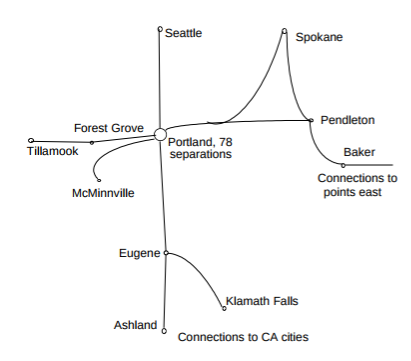
My duties were to sort mail, which came directly from the post office or from a connecting line. Say there was mail for Salem, Woodburn, Albany, and Eugene all in one mail pouch for the Southern Pacific line. I would route it and separate it. The letters would go in a separate box for each city. The highest number of separations was 110 cities. I never looked at the label; I memorized the case. Generally I had 78 separations and worked it down to the carrier route. I’d learn the systems of the different cities on my line. I had a record once, 38 letters a minute for 25 minutes with one mistake, because a pigeonhole was too low. They used a stop watch to time me; it was like a survey.

As long as we cleaned up, we could go our own pace. I prided myself on my experience and knowledge. But I couldn’t take the examination. There was a periodic examination, every one to three years on any one different distribution, say the Baker line to Idaho, Wyoming, Utah, and east of there. I was up on the distributions for Washington, Oregon, California, Arizona, and of course Portland City. We were supposed to pass with a 90% or better. We were also examined on postal laws and regulations. I did all right on those. I practiced with a set of cards and a case. Some used a map. I memorized everything without using a map though. Somehow I got through those examinations, but I never did well on that eastern line through Idaho and all.

Diary excerpt, May 21, 1940: “Drove to town. Took Black Book exam, at Baker’s office. Passed 100%. Got 25 merits on all exams.”

A typical mail run went something like this excerpt from my diary:
“January 28, 1940: Lillie, Carl, Alice, Marjorie, and I left home about 3 P.M., for Portland. Got to my folks’ place before 4, stayed more than an hour. . . . Folks took me to the depot. Out to the car at 6:40. Changed clothes. Hung sacks, and labelled the rack. Mail very light all evening. Did not do half an hour’s work before 9 P.M. Cleaned up everything near Bonneville. Train on time all night. Still much snow at Hood River. Some snow all the way. Mail light at Pendleton. Napped most of the way. Felt better by daylight. In Baker on time. Heavy frost; but, clear sky. Ate breakfast at Walt’s. To bed about 8:30.
“Monday, January 29, 40. Got up about 1 P.M. Shaved. Answered some correspondence. Walked up town. Bowled two games with Mr. Baer. Was away off. Lost both games 136-108 and 138-78. Got razor blades and pencils at 15¢ store. Back to Walt’s, to eat soon after 4. Up to the room. Put a fire in the stove, as there is now a chill in the air. Wrote in this book, for more than an hour. Finished to here, just as Tr. 44 came in, a few minutes late. Dow Phillips and Chet Lewis were the crew. Chet’s father, nearly 76, is no better. He will likely not last long. Down to Jess Smith’s to get ice cream and a writing tablet. Back to the room, to write a letter to Ross. Over to the depot, to change clothes at 7:20. Our train came at 8 o’clock. I worked Washington and No. 1 & 2 Oregon papers, finishing near Gibbon; then, helped Davis on City letters to Boardman. Rested a little to Arlington. Got lunch there. Bitz was helper. Finished City mail as we got to The Dalles. Robbed the box there. Cleaned everything up, just below Hood River; and rested to Portland. On time there. Helped put the mail out. Took the registers to Northern train. Changed clothes. Walked up to Post Office to leave a letter at the Chief Clerk’s office. Then up to the bus depot.
“Tuesday, Jan. 30, 1940. Got coffee and donuts at Lewis Cafe. Bo’t a round-trip ticket to McMinnville. Left for home on 7:30 bus. Got to Mc. at 8:40. Bus now takes the direct route. I got off at 5th & Baker. Walked two blocks to home. Breakfast. Took a nap. Stamped slips and labels after supper. To bed early.”

The chief clerk was critical about my attitude on smoking. His name was Fred Tuey, and of course he was a smoker. The colonel was the medical examiner at the Veteran’s Administration and he declared me to have a total disability. I had headaches, nausea, respiratory problems, and it was because of the smokers. I retired in December 1944 and was then on the U.S. Civil Servant Retirement Board. I got $240 a month as my highest salary, which translated into $1000 a year retirement, or about $83 a month.

Politics of the Depression and World War II


In 1929 the financial troubles of the Great Depression had no repercussions on us. A few in the church felt it, but not us. Pert near everybody had to retrench a little. Our wages at the R.M.S. were guaranteed. Throughout the Depression we did well; in fact, along about 1931–32 we began buying new cars instead of used cars.

Franklin Roosevelt was elected in 1932 on the New Deal platform. He initiated the Parcel Post system, which gave us a more solid body of business. There were more clerks hired. He put the Federal Reserve into effect, and he held a firm whip over the Congress. I went along with Roosevelt. I liked what he was doing. But Uncle Henry Porter said to me in 1936, “Do you think Mr. Roosevelt will be elected a second time?” I said, “Yes, I do.” He said, “Oh, I fear for the safety of the country.” Uncle Henry Porter was a better religionist than Republican anyway. The New Deal was so innovative; something new was passed every Congressional session. It was radical, but it was for the good of the common people. The common people are still reaping the benefits of the New Deal. When the news came over the radio in April 1945 of Roosevelt’s passing, they said, “The Old Warrior is gone.” I was very much saddened at his passing.

Along in 1939 when World War II was starting, we had had warnings of what was going on. Hitler had signaled what he was going to do, but the world waited until he struck. It redoubled my hatred of the German people, for them wanting world domination and for believing in the superiority of the Teutonic race. Chamberlain was an apostle of peace, not necessarily wanting peace at any price either. He was ready to negotiate, but the Germans put him in a position where he couldn’t negotiate any more. The German forces struck and Chamberlain’s idealism was crushed.

Diary, Wednesday, Oct. 16, 1940: “This is registration day for all men ages 21 to 35 for military service. First time that this country has ever had peace-time conscription. We hope our boys do not have to fight. Perhaps the show of strength will be sufficient.”

On December 7, 1941 we were surprised! We were in church, and afterward John and Viola came to visit and told us about the Japanese attack on Pearl Harbor. We were stupefied. We were dealing with a heathen nation there. You look what goes on elsewhere—you can’t Christianize Mohammedans any more than you can Jews. They do everything they can to persecute Christians. “Treachery!” was the only thing we could say on that day. Roosevelt got on the radio and said, “This day will live long in infamy!” because they had struck under cover of diplomatic negotiation.

It was not the time for the Millennium to begin, but people thought of that at the time. Some of them were so silly, they went out on the hills, made Ascension robes and wore them out there, thinking they were going to meet Jesus Christ at his second coming and be bodily carried up to meet him.

The war rationing affected us. We had to have stamps for groceries, and gas was allowed only so much a week. We found we couldn’t go in to Oregon City to church every week, so we put our membership in to Stafford Baptist Church for a year or so. There were higher prices during the war; there was profiteering going on that was not necessary but present due to greed. We had to put up with inflation.

The emotional impact we felt was in what our sons-in-law encountered. Herb was too old and was not called up, but John Crawford, George Jones, Carl, Clarence, and Claude were. George served in the South Pacific and went to New Zealand and back up through the South China Sea up to Okinawa. He was among the first to set foot on Japanese soil; he landed at Hokkaido and went up to Tokyo from there.

John went from New York to North Africa and fought in the Battle of the Bulge in Belgium. He was with the occupation army in Italy. He was ferried across the Mediterranean and was under fire all the way up to the French border where the Germans made their last stand. They came near wiping out the Allied army, but they turned their flank and barely won through. John was among the first to be mustered out.

Carl and Clarence went just to training camps; they didn’t have to fight. Carl went to New York City and to the area of West Point, training with the Army. Clarence went to bombardier school in Roswell, New Mexico with the Air Force.

We were living at Stafford most of the time. Loretta was with us for almost a year while George was away. Rodney was born while she was with us. Alice was also with us for a little over a year, but not at the same time. Claude was in the Navy out in the Pacific. His family had lived just behind us over the hill in Stafford.

Truman was responsible for the bomb, the atomic bomb that they dropped on Japan. I agreed with it, but I had no inkling of what it meant until afterward. But the end justified the means, though Christ said, “Those that live by the sword shall perish by the sword.” Ours was not a war of aggression, it was a war of defense. Your motivation for fighting a war puts you either on the side of the aggressor or the victim. And then you have to accept the consequences.

In 1952 when the Korean War started, I voted for Eisenhower on account of his war record. I felt we were justified in going into Korea; we had to prevent the spread of communism. The aggressors were aided and abetted by the Chinese communists.

It was the same for the Vietnam war. We bombed Hanoi when the Pueblo was seized. We had to go in there and bring the Pueblo out!

Diary, Spring 1945:
“Have neglected this for more than a year.
“Much has happened. My run was arbitrarily changed again. . . . I had to go on the night train again; and, have to work City mail again. Have no alternative, due to seniority rules. Have to work on a four-day schedule, too. Assigned to work with Roomed at Crabill Hotel at Baker. Poor place to stay. Have decided to apply for retirement as soon as I begin to feel bad again. Made my trip on March 27th. Felt my trouble coming back again; and, rather than risk being disabled, I laid off until July 6th. I drew full pay until May 12th. I was on personal leave until I went back to work again. I started building a house for Carl on our place. On May 12th I fell off a ladder and hurt my knee and right arm, and bruised my nose. Was laid up for several weeks and felt the effects of the fall for almost a year. I drew $147.00 disability, from the Federal Employees group insurance. When I went back to work, I was placed on the Arlington helper run on Trs. 26 & 25. It was the worst assignment I ever worked.
“I had to work every other day. Had more time at Arlington than at home. I laid off for most of the month I was on the run. Went back on Trs. 18 & 17. My application for retirement was still pending. I was ordered up for a physical exam on Aug. 18th (1944). I was up at Veteran’s Hospital nearly all day. Had to hurry to get to my work on time.
“Soon got a letter from the Civil Service retirement Commission asking if I still wished to have my retirement considered. They said my superior officers had said I wished to withdraw my application. It did not take me long to tell them that at the least they had been mis-informed. About October 12th I got a letter from my Chief Clerk’s office, stating that due to my work on my farm, I was neglecting my work on the road. I did not reply. About that time, I also received a proposal for demerits for defaulting the Washington examination, from that contemptible Hicks, a misfit in the Examiner’s office. About October 18th, came notice of my application approval. Chief Clerk Twohy received it on Sunday, two days after it came to me. He was so dumbfounded that he called me on Sunday. He asked me what was wrong with me. I told him that they would not tell me.
“I made arrangements to finish my work on the road with the trip out of Portland on Nov. 14th. I came in on my last trip on Tr. 17 on the morning of Nov. 16. Due to accumulated leave, I received full pay for November.
“Certainly enjoyed several months of working around home. My first annuity check came on Jan. 10th, 1945. Since then, they have arrived regularly on the 5th of each month.
“Loretta and Donnie are still with us. George is now in The Philippines. He was wounded on March 31st, their wedding anniversary. Their second boy was born on January 20, 1945, at Hahnneman Hospital. They named him Rodney George. George and John were both here on furlough about Nov. 15th, 1944.”

Weddings of the Children


Herbert was the first to get married. In Vancouver, Washington at that time, there were professional marrying parsons at the courthouse and young people went up there often to get married in a hurry. Thelma’s family lived at Lake Grove and attended the local Presbyterian Church. Her sister Eleanor went with them to Vancouver; we took them up there in our car. They didn’t want a big wedding or reception. Her family couldn’t afford it and we didn’t care to. We were not in favor of their getting married right then, but it was the same situation as we had experienced ourselves to some degree. We liked Thelma; she was one of the family. She had good common sense. We took to her.

Viola was next. We lived in Condon, and both Viola and John went to high school there. They married the 3rd of June at our home in McMinnville, with the Rev. Jimmy Osborne officiating. Everybody was there except Charlotte, who lived at Grande Ronde then. When it was time for the wedding to start, we all just gathered around, in our street clothes, nothing fancy. Loretta and George were next. They went to Vancouver by themselves; they didn’t tell us. George lived next door to us in McMinnville. George’s father worked for Lillie’s father on his farm.
George and Retta on their wedding trip

Ernie Redding and Charlotte, 1939
Charlotte and Ernie also met in McMinnville. He was also a close neighbor of ours, like George. They got married in Vancouver by the Marrying Preacher. We took them.

Diary, October 6, 1940: “Ate dinner about 1 p.m. Clarence was the only one of the family not there. He had to take care of the store. Of course, this was our wedding anniversary dinner. There are now 18 of us—quite a tribe. The two new ‘daddies’ Ernie and John ‘cut quite the figure,’ walking down the street, trundling baby buggies.”

In 1941 after he was mustered out, Carl worked for Boeing in Seattle and met Dorothy. She was a member of the Sunnyside Brethren Church. They were married there in early 1943 and Lillie went, but I didn’t because I was working. Clarence,Alice, and Marjorie went too, with Holly Davenport. Dorothy’s parents lived there in Sunnyside.

In 1945, Alice married Bud, Thelma’s brother, in Vancouver. We knew it wouldn’t last. He was too jealous. We gave it a couple months, and that’s what happened. She got an annulment. Now Claude had been in the Navy and his family had lived on the hill behind us in Stafford. The kids used to pick strawberries together. When Claude got out of the Navy and came to see Alice, she said, “Tell him I’m not here!” But she soon changed her mind. They went to Bothel, Washington to get married.

Marjorie met Fred at a dance. You never know who you’re going to meet at a place like that! They got married April 2nd in Stafford Church. It was a nice church wedding.

Diary excerpt, Friday, April 2, 1948: “Well, well! Here it is three weeks later; and, how I have neglected my little diary in that time. We had just all gotten assembled at the church, for Marjorie’s wedding. Loretta was matron of honor. She certainly looked pretty; but, was she scared! Her hands shook so much she could hardly hold her bouquet. Myra and Virginia were bridesmaids. Patty DeNeui and Margaret Walters lighted the candles. Lucille sang so beautifully: ‘God gave me you’; ‘Because’; and ‘The Lord’s Prayer.’ My part was to give away the bride—our baby. Lillie looked so cute that I almost kissed her. Seriously, it was a beautiful wedding. Leland Friesen gave his usual impressive ceremony, with humorous quips interspersed, so as to relieve the tension of the bridal party. Cake, punch, and coffee were served in the basement afterward. Thelma served punch, and Viola cut the cake. Mrs. Walters and Mrs. Elligsen with some of the girls, served in the kitchen. Some of the boys put up a road block; and, otherwise interfered with the ‘get-away’ car; but, all had a nice time. Relatives (ours) present were: my mother, Aunt Pauline, Aunt Lena, Roy and Mildred, Guy and Edith, Clifford and Harriet, Thelma and Beth; Loretta and George and two boys: Donald and Rodney; Clarence and Myra; Agnes, Edwin and Thelma and two children; Mildred Gehring and two children; Charles and Nell Munro, and Aunt Ada.”

Myra and Clarence wedding, August 1948
Clarence met Myra in college—Northwest Christian College in Eugene. They were married 21 August 1948 in St. John’s Christian Church just outside of Portland. Lillie and Loretta and Viola were all there, and Carl and Dorothy and Herbert and Thelma; my mother and my aunts; Lillie’s sisters; and some cousins. Marjorie couldn’t be there; she and Fred had moved back east. Charlotte couldn’t come; she was in Canada. There were a number of our friends from Kern Park Church. I was working out of Oregon City. Maybe Alice and Claude were there too—no, no, he couldn’t leave his job right then. Myra’s parents got there two days later. Their ship from the Congo had been delayed. But it was a beautiful wedding.

Barbara married Walt in our Mill Creek home. Earl Lyda married them. She had met Walt while picking beans. His folks would come over every night. We enjoyed them. At their wedding Myra and Clarence and Loretta were there.

After the Railway Mail Service


After I retired from the Railway Mail Service, I had to get another job. Charlie Munroe [a cousin of Lillie’s] had a carpentry concern in Oregon City and we had built 11 of our own houses by then, as well as helping build churches and other houses. I liked house building, from the foundation to the roof. We even did the finishing carpentry. He didn’t use union men. He paid us cash, $1 an hour and no deductions. We were out in the weather though, so it was largely seasonal. We were living then at Stafford, early spring of 1945. Charlie worked steadily year round.

We had a bunch of chickens. Once a week we’d take the eggs into town and peddle them. We had a regular egg route. I drove the school bus for West Linn High School until after Marjorie graduated. That was $5 an hour. When I quit I went back to carpentry.

In 1950 I went to work for the Clackamas County Assessor, Rufus Wood, as a real estate appraiser. I appraised houses for county tax purposes. I’d take pictures, measure, inspect basements, look at the construction details such as the joists, centers, etc. I gave a conservative value and depreciated older homes. I was earning $240 a month and got a 7¢ a mile allowance for using my own car. My boss lost his job in the next election in 1952, so, so did I. He was a member of the Oregon City Christian Church. He was not too hard to get along with, although we quarreled occasionally.

I went back to Charlie Munroe and found that he was looking for a business. John Crawford and I went down the coast looking at motels. Nothing looked good. He contacted two guys who were contractors at Port Orford, Webber and Scribner. They wanted a little money to establish a building supply at Port Orford so they could get supplies. Somebody came up here to buy a truck, for $8,000. It was a GMC diesel truck. We contributed $2,500 cash each. John was not in on that part of the deal, but he came in later.

Webber’s son drove the truck for $8 a day. I stayed up here and met with the son and went to wholesale houses and picked up stuff with him. We rented an old building with double doors down at Port Orford. A wind storm blew the door off and ruined our stock. The owner charged us with negligence and we won. They called me and I went down in January 1953 for several weeks. While down there I had to deal with Les and told him, You’re fired! So then Scribner drove the truck. I had to make my headquarters down there, so I left Lillie and Barbara and I moved down just before school ended. I hired a carpenter to be the third man with Scribner and me when Webber quit from our partnership. I told John that Webber wanted out. John dealt with him, paid him $800. Scribner then wanted the truck in a certain warm locality with its back broken, so I bought Scribner out; John gave him $500. So I had a business of my own.
Beach at Port Orford

In July 1953 we moved Lillie and Barbara down. We rented one end of a duplex at first. Then we started running our Mom and Pop business, which we ran for eight years. I hired whomever I could get to drive, log truck drivers or whomever. After Lillie was down there, I’d go along to do the buying. Claude and Alice came down in September 1953. Claude drove the truck through the winter and I’d come along. In spring ’54 he put in a body and fender shop. We hired Tom, Dick, or Harry to drive truck for a year. In the spring of 1955 I tried to drive, but it had a bum shift and I would kill the engine.

Once I hired a driver to make the trip named Einer Holmquist. He thought we ought to drive at night. We left in the afternoon and got to Lincoln City, where he lost control. He had booze in his jacket pocket and was sipping it with a straw as he drove! We left the truck in a yard and he went to the hotel. I told him, “You show up in better shape!” I went to Retta’s to stay over night. Next morning before 7 I went to the yard to start the truck and warm up the motor. Then I went to a restaurant to get breakfast. I said to the staff, “If Einer comes in . . .” and they interrupted me, “Your driver was here and left a note.” It said, “Mr. Read, I’m not in shape this morning to drive.” I started and drove out, I was so mad! I had a dozen calls to make to pick up the whole load. After I was done I went back to the truck terminal. The driver had been in once. If he doesn’t meet me, I thought, he’ll get left! I got out and went home. I got home at midnight. His wife came in and I gave her $5 for groceries. Alice saw her later drunk outside of Orford’s.

So we didn’t hire any more drivers. I made the trip myself two or three times. Then a customer came in who was working with a lot of plywood. He sold cars and trucks and knew of a guy in Newport who would trade us a truck for our truck, which had 16 shifts per mile and was five years old. This other truck was brand new and had a gasoline engine. The fellow who wanted our truck was working on gravel beds and our truck would be better for that. So we took the bed off our truck and swapped it for the bed on the other one and traded straight across. Everybody was happy. It was a 12 ton haul. It weighed 5 ton and the gross load was 17 ton. We could put more on, but then it would lug on the hills. An 8–10 ton load made us good pay.

Lillie made us a lot of business. She was very friendly and visited with everyone who came in in such a way that they always came back. Sometimes these old bachelors would come in about 5:30 and keep her visiting until long after 6, our usual closing time. We were the main representatives for accommodation for that entire area. We’d have to open after church to take care of phone-in orders, and to go get stuff. We made one mistake, and that was in allowing unlimited credit at first. We learned you have to make a limit. Only a couple of contractors ever cheated us; we lost about $1600. One store owner paid us and his contractor disappeared with the goods.

While in Port Orford we were actively engaged in the work at the Port Orford Community Church, where mostly Christian church preachers were hired. In 1959, we withdrew from the Community Church and helped organize Port Orford Christian Church. Albert Kribs was called as pastor. This church didn’t survive, however, as so many moved away.

Most of our building supply customers were young people just married who had never lived anywhere else. They’d come in with a picture of a large, ranch-style house. I’d ask them, “Do you have a lot?” [A piece of land.] Sometimes. Paying on it. “If you have a place, how much do you have?” They’d tell me they had anywhere between $0 and $500–600. I’d tell them they were asking me to pay for it. I’d say it has to be paid for. They’d go home to think and then come back with a more realistic picture.

We’d start with a concrete foundation. You can’t build on stilts! Blocks and later concrete. We’d pick out #3 or #4 lumber. There was some waste and some economy. I’d show them how to use it. We’d cull the lumber. I’d tell them one load of lumber was $20 and if they had to have it delivered, it was $35. I’d show them how to do the framing, show them how to do their own work. All the guys from the mill would come and pitch in to help them put up the frame and roof in a day.

Now, with the frame up, I’d tell them to get in there and start nailing. The woman could nail just as well as the man. I’d tell them, do all you can do by yourself. Keep it paid for as you go along. By the 10th of the next month, pay for the month before. I’d do the work they would have had to have hired done. If nobody was there to supervise, I’d supervise. I’d deal stuff out as they could pay, especially the finishings. Some we insulated, with tar-felt paper mostly. When “our kids” would get into their houses, they’d come out and say, “Oh, Mr. Read! We’re glad you didn’t let us run a big bill!” Our kids.

There was a lumber mill across from Pacific High School, and we sold to him in 1960. He wanted a place to sell his plain lumber. I liked to buy from a smaller mill rather than from Bandon’s. The yard man at Bandon had run us into bankruptcy in one year.
Columbus day storm 1962, uprooted tree in Port Orford
After the windstorm of 1962 we were $10,000 in debt and wrecked. We didn’t prosecute. He deeded the place back to us. We took it back, repaired the building, and restocked it. We sent in a claim to the insurance company. The adjuster gave us a total loss and paid all the bills. We sold it to Alice and Claude with no down payment necessary. The neighbors from all around came to help repair the building. They brought a log truck to pull the building back down onto its foundation. The wind had taken the north side off the building.

This all was very hard on Lillie, who besides trying to run the business was taking care of Barbara, whom we had adopted as a little six-year-old back in 1951. But all in all, we enjoyed our time in Port Orford.