The Hogans
You all have known for many years that I wanted to find Solomon Whittenton’s wife, Mary (I wrote about them here), and discover her heritage. Finally!! With the help of a cousin who discovered me last June, I have got some of the information we were waiting for.
Who They Are
Mary belongs to the Hogan family that in 1850 lived very close to Solomon and his sister Agatha near Jackson, Madison County, Tennessee. You can see on this image that Solomon and Agatha are the second household on the page. Then next door are their father and stepmother and their other siblings. Next are the Kendricks, rich old Jane and her family who owned quite a lot of slaves. Next to them are the Hogans. The father is Marmaduke, born about 1792 in North Carolina, and his wife, Nancy McGregor Hogan, born about 1798 also in North Carolina. They came from Montgomery County, southwest of the places where the Whittingtons were from.
Mary is reported to be 25 years old on this census. This is probably close to the truth; but I think she was actually 24. Her sister Elizabeth is said to be 17; she was probably 15 in reality. The youngest brother, Sandy (Sanders) is reported to be 14; he was probably 12. There were three older brothers, Jonah Calvin (born about 1820), Caswell (born about 1823-4), and Isaiah (born 1825).
Hogan is an Irish surname. As derived from the Irish Gaelic, Ó hÓgáin, it is a diminutive of Og meaning “young.” The Cornish version of the name means “mortal.” The Welsh name Hogyn means “stripling.”
Marmaduke Hogan’s parents are Zachariah Hogan and Celia Bannister. His line goes back four more generations in North Carolina and Virginia before you reach the Irish ancestor, Patrick. The Baxters and Griffins whom they married were also originally from Ireland, all in the Dublin area. The Bannister line isn’t developed yet.
Nancy McGregor’s grandfather came from Perth, Scotland. I don’t know much yet about her mother, Ann Harris, but Harris is a name that occurs frequently in Scotland, as it does in England.
The Evidence
Once I saw on Valerie Whitenton Hart’s death record that her son thought his grandmother’s maiden name was “Hogins” (Valerie is our Mary Jane’s older sister), I started looking for any surnames that had H, G or K, and N with any vowels at all, since pronunciation can vary so much you never know which vowel was originally the right one. I landed on this Hogan family, but I couldn’t see any proof beyond circumstantial evidence that they might be the right family. I didn’t research them particularly, beyond looking to see how many of these families were in Madison County, Tennessee. Then I dropped it as there was so much to do elsewhere.
Like I said, last June I got connected with a descendant of Lillie Read’s half-brother Sam. She gave me a lot of stuff, which I have since been sorting through now and then. Not until this week did I realize that she had this line on Ancestry, and I asked her what the evidence was. She pointed me to where everything was and also gave me information about various DNA tests.
All of the recorded historical evidence is circumstantial, which is why I didn’t trust it alone. The Hogans came from North Carolina, as did the Whittingtons. To be sure, the Hogans were in Montgomery County, southwest of the Whittingtons in Johnston and Wake counties. Before that, the Hogans were in Anson County, next door, which is where they arrived from the area that is now Cumberland County, Virginia, to the north, around 1700 (at the time, that area was contained in Charles City and Henrico counties). Anyway, the same general migration pattern applies to both families. And in fact, the McGregors were first to go to Tennessee from North Carolina, arriving there before 1820.
When the families settled near Jackson in Madison County, Tennessee, there would have been plenty of opportunity for Mary and Solomon to meet and become well acquainted. But here is where things get a little weird.
You all remember that Solomon didn’t behave himself well with the ladies and had an illegitimate child around 1840. It sets a precedent for the next thing that is outside the accepted order of things. I have found that Mary Ann Hogan got married on 19 November 1848 in Montgomery County, Tennessee, probably in Clarksville at the County Courthouse. Frustratingly, the index search engine online requires exact spelling, and I have tried every form for “Whittington” I can think of and haven’t gotten a hit that shows Solomon in the index. So I don’t know the name of Mary’s groom. The index is separated as to brides and grooms. I’ve sent for the full record and will know more once it arrives, but it opens up some big questions.
Is this marriage record the missing proof we need for Solomon’s wife’s true identity?
If Mary Ann Hogan got married to Solomon then, why was she living in her father’s house two years later when the 1850 Census was taken? Was she just visiting when the census taker came and they all confused him as to who lived there?
Why Clarksville when they were all living in Madison County?
Was Valerie Whittenton right in 1900 to say that she was born in March 1849? Or was she born in 1850? She still should have appeared somewhere on the census, whether in her grandfather’s house or her father’s—because she was born in March and the census taker came in November.
If this isn’t the right Mary Ann Hogan, who is this? If it is the right Mary Ann Hogan and she married someone else before Solomon, whoa, that’s going to open up another big can of worms, and then where and when did Solomon and Mary get married?
Stay tuned. I’ll update this with the information I find out on that marriage record when I get it.
In all, the circumstantial evidence is that of Mary Ann Hogan having the right name, being the right age, living in the right place, and of her family following the same migration patterns as did the Whittingtons. Sounds thin, doesn’t it?
Meanwhile, my distant cousin told me that she has been able to create DNA connections with a very high confidence rating that include descendants of Solomon and Mary Whittenton and also descendants of various siblings in the family of Marmaduke Hogan and Nancy McGregor. This was using two different DNA processing companies, and that means almost certainly we have the right Mary Ann Hogan, because DNA is that accurate! Now that I’ve linked the Hogans on my own online tree, I expect I’ll soon be getting the same information from the company I used for my own DNA test.
What Do We Know about Mary’s Siblings and Their Families?
I’ve been researching Mary’s five siblings and have come up with some information about each of them. They are Calvin, Caswell, Isaiah, Elizabeth, and Sanders. We’ll start with the eldest and get to the youngest last.
Jonah Calvin Hogan has a birth record in Montgomery County, North Carolina, but all that is available online is the index that doesn’t give the date. Still, other records support us in thinking he was born about 1820. No other record uses the “Jonah” given name; he apparently went by Calvin exclusively. The U.S. 1820 Census for Montgomery county was burned up in a fire in 1835, so we can’t see the family composition then. In 1830 Calvin appears as a checkmark in the age 10–14 column. In 1840 he appears in the age 15–19 column, although we expect him to be 20. In 1850 he has his own household and is age 30.
While still in North Carolina, Calvin married a woman named Mary who was born about 1822. Their children are Atlas (1842), James (1844), Sarah E (1846), and Zachariah (March 1850). Atlas was born in North Carolina; the rest of the children in Tennessee, probably in District 17 of Madison County where they were living when the census was taken. Two more daughters were added to the family: Mary Lou in 1852 and Frances in 1857.
I can’t find any record about Calvin after that census. There are other Calvin Hogans, but none matches him. His eldest son Atlas served in the Civil War, and interestingly, changed sides. He started out in the 13th Regiment Arkansas Infantry, Company I when he was 18 years old, entering as a private and being captured when he was a sergeant and sent to prison in Indiana. There he apparently made a deal and entered the Union Army on 10 September 1864 in the 21st Regiment Indiana, Company F, 1st Heavy Artillery Unit. He served with them until they got to Florida in 1865 and was mustered out 27 July 1865. Back in Madison County, Tennessee, he soon got married to a Miss Sarah J.E. Stephenson.
Next comes Mary Ann’s brother Caswell Hogan. He was born in Montgomery County, North Carolina, in about 1824. The 1830 census shows he is age 5–9. In 1840 he is age 15–19. In 1850 he appears with his wife and two children and is reported to be 27 years old. In 1860 he appears with his family on the census and is 36 years old.
Caswell married Jane Johnson in 1845 in Madison County, Tennessee. Jane was about the same age as Caswell, born in North Carolina, and went by the nickname Jennie. They had the following children in Tennessee: Amanda (1846), William (1849), Thomas A (1852), Christopher Columbus “Lum” (1855), Elizabeth (1856), and Robert Merida (1858). Right after Robert Merida was born, the family moved to Craighead county, Arkansas. Cas was a farmer, and both he and Jennie were illiterate according to the 1860 Census. Cas died in 1863 in Conway, Arkansas. Jennie lived until 1896.
The next sibling for Mary Ann is her brother Isaiah, who is next to her in age. He was reportedly born 27 August 1825 in Montgomery County, North Carolina. The 1830 Census has him in the “Under 5” age group. In 1840 he was put in the 5–9 age group, and in 1850 he’s 25 years old, living in Madison County, Tennessee with his wife, Sally, who is the same age. Then Sally must have changed her name, because in 1860 he’s married to Lucy, and they have three children: James (1852), Susan (1855), and Hiram (1858). They live in Ripley County, Missouri, but little Hiram was born in Arkansas, so they must have tried living there between Susan’s and Hiram’s births. When the Civil War started, Isaiah chose to join the Union side in the 24th Regiment Missouri Infantry, Company G. He was either captured and sent to Andersonville, Georgia, and then sent home to die, or he was killed in a battle; it is not clear which record belongs to him. At any rate he died 28 January 1863 in Van Buren, Carter county, Missouri, and his widow, Sarah, applied for a military pension the next month, which was granted.
After Mary Ann comes her sister, Elizabeth, born in the 1830s. Her age varies so much in the records that it’s hard to know exactly when she was born. In 1840 she was reported as under 5; but in 1850 she was supposedly 17. Then in 1860 she was 25. She married Thomas Smith (a native of Ireland who was born about 1821 and who had immigrated to Arkansas) soon after 1860 and had four children: William Burns Smith (1862), Allice (1864), Thomas (1865), and Edward (1868). Elizabeth was said to be 36 in 1870, so perhaps her birth year was 1834 or 1835. Nothing further is known yet of her life; she is said to have died in Faulkner county, Arkansas, in 1880.
The youngest of the siblings is Sanders Hogan, born between 1836 and 1838. The 1840 Census shows him in the Under 5 group; in 1850 he is said to be 14 years old, but ten years later he is said to be 22. Of course he moved with his parents from North Carolina to Tennessee and then to Arkansas. Nothing further is known of him. His actual name may have been Alexander, since Sanders is a common nickname or short form of that name. There are many Alexander Hogans, but again, I don’t know what happened to our Sander, or “Sandy” as he is called on the 1860 Census.
The Hogan family was not a particularly long-lived family. The father, Marmaduke, lived over 75 years, but his wife, Nancy, was only around 56 or 57 when she died. Calvin was about 40 when he disappeared from all records. Caswell died at the age of about 40. Isaiah died at the age of 37. Elizabeth was around 44 when she died. Sanders could have lived a long time, but he disappeared from records at the age of 22. Mary Ann lived the longest that we know of; she was around 60 when she died.
What’s Next
I’m going to explore Mary Ann’s ancestors and try to discover when each family arrived in America. I’ll update you with what I find.
All content on this blog is copyright by Marci Andrews Wahlquist as of its date of publication.
Showing posts with label Solomon Yancy Whittington. Show all posts
Tuesday, April 10, 2018
Friday, February 20, 2015
Solomon Yancy Whittington and Mary A Hogins, an Expanded View
Solomon Yancy Whittington (his name was spelled Whittenton in later records) was born in Wake County, North
Carolina on 20 July 1813, the eighth child of James and Frankie Whittington. He
was named after his father’s younger brother Solomon, and Yancy was also a
recurring family name. His older siblings were William, Richard, Agatha,
Telitha, Gibson, Weston, and George, ranging in age from 14 to 2.
When Solomon was perhaps about 5 years old, the family gained a slave
named Dolly from Solomon’s maternal grandfather’s estate. Soon his father
purchased another slave, a young man who worked in the fields. Solomon grew up
helping his father and older brothers with the farm work.
He appeared on the 1820 and 1830 census records living with his
father’s family in Johnston County, North Carolina. By then the family had
grown to include thirteen children, but the eleventh child had died young.
Solomon’s father had sold the male slave and bought or otherwise acquired
another female (she might have been Dolly’s daughter). All nine sons apparently
worked as farmers and learned to do all the hard labor associated with farming
in those days.
The family moved from North Carolina to Madison County, Tennessee, in
about 1838 when Solomon was around 25 years old. He was living in Madison
County near Jackson in 1840 with his father’s family when the census was taken
that year.
The young man seemed to have gotten into some trouble over a young woman
soon after the move, for in 1841 Solomon had to appear on a charge in civil
court that he was the reputed father of the child of a woman named “Louvisey
Manor” in McNairy County, which was not far south of the Whittington home in
Madison County. However, the court ruled that since the woman and child in
question had been continuously residing in McNairy County for the two years
since its birth, the Madison County Court refused to have jurisdiction over the
case and it was dismissed. Nothing more is known of whether this really was
Solomon’s child, and it is further not known whether he ever paid anything to
the mother.
There could be some truth to the story—probably Solomon did have some relationship with the woman at least, but he never did acknowledge the child as his and nothing more was ever heard about it, so perhaps he was not the child’s father after all, or perhaps he paid the woman a sum of money as was common in such cases, and that was the end of his relationship to both. A search of the 1850 census records has not turned up any possible matches for these people. McNairy County does not have any court records from that time period, so far as is known, and there are very few other records in McNairy County other than probate and cemeteries that go back before 1850.
Still, Solomon ceased living in the family home after that and his
sister Agatha came to live with and keep house for him, bringing a 13-year-old girl
with her whose last name matched Agatha’s married surname. In that census,
Solomon was reported to be 32, which shaved five years off his age. He had no
property reported but was a farmer, so it is likely that he was working for his
father next door.
Solomon seemed to be poorer at this point than most of his brothers.
Even the younger brothers had more property than Solomon. Was he the family
“black sheep” for having been hauled into court over a matter that was seen as
staining the family honor? Or did he have to pay a substantial sum of money for
the child, and was that seen as his portion of the family inheritance?
Solomon was supposed to have married Mary A. Hogins soon after the
November 1850 census report, but another mystery surrounds their early relationship.
Their eldest daughter, Valerie, reported her age in later census records so
that she could have been born in 1849 or 1850. Her birthday was in March. But her
reported ages do not fit with the 1850 Census report—there was no Mary and/or
Valerie in Solomon’s household, and there was no Valerie Hogins or Whittenton
anywhere in the county or the state recorded on that census. If she were born
in March 1851, then certainly her mother was pregnant when the census taker
recorded Solomon’s household. Either they were there in the household in hiding,
or nearby but not recorded on that census; or Mary got together with Solomon
soon enough after the census for Valerie to be born in March 1852, and then being
illiterate, Valerie was unable to figure out her correct age for most of her
life. No marriage record has turned up for Solomon and Mary, although all of
the rest of his family have marriage records from before and after that time.
Perhaps Solomon and Mary got married in a neighboring county, or they simply
cohabitated and declared themselves married. This all makes Solomon look more
like the “black sheep” of the family.
Mary Hogins is a mystery to us. She was born in either North Carolina
or Tennessee in about 1820–25. Her last name comes from Valerie’s death record,
so it is the memory of a grandson trying to recall what his mother (Valerie)
had told him, and who knows whether what Valerie said was an accurate
reflection of what Mary had told her many years before. There are several
Hogins families in 1840 living not too far away in Dickson County, northeast of
Madison County, and one of them could be Mary’s family. All contain females of
the right age, but we need corroborating evidence. There are two or three other
Hogins or Hogan families in nearby counties with single women named Mary of the
right age range to be candidates, and finally, there is a Hogan family right in
Madison County in 1850, living very near Solomon’s and James’ households, with
a 25-year-old single woman named Mary in it, and this could well be our Mary,
but all is still guesswork at this point. More research is needed, and some
luck.
The next year, on December 20, 1851, Solomon’s father gave him fifty
acres of land in Madison County, Tennessee. But a month before that, his father
had given his younger brother more than twice that amount of land. It was
registered on August 10, 1853 (probably right after his father’s death). The
inequity is interesting. And the timing is also interesting—assuming Valerie was
to be born the next March, perhaps Solomon had married Mary and was “rewarded”
for it. We really can’t know what the truth was.
I’m going to give Solomon and Mary the benefit of the doubt and assume
they married about December 1850 when they were 37 and 30 years. They had eight
children:
- Valerie Jane Whittenton, born March 1852 in Madison County, Tennessee.
- William Whittenton, born 1853 in Madison County, Tennessee.
- Mary Ann Whittenton, born 1854 in Madison County, Tennessee.
- Frances Elizabeth Whittenton, born May 1855 in Madison County, Tennessee.
- Mary Jane Whittenton, born 1857 in Madison County, Tennessee.
- Jos Laney Whittenton, a daughter, born June 1860 in Madison County, Tennessee.
- Thomas Jabe Whittenton, born September 1861 in Madison County, Tennessee.
- Bedford Forrest Whittenton, born 1864 in Madison County, Tennessee.
The population schedule of the 1860 Census, taken September 6th
that year, recorded that Solomon was 46 (he was really 47), Mary, was 40;
Valerie was 9, William was 7, Ann was 5, Frances was 4, Mary was 3, and Jos
Lane was two months old. They had one man, Alex Dixon, age 50, living with them
and probably working on the farm.
Meanwhile, the 1860 agricultural schedule, taken the day before,
showed that Solomon had land worth $1000. He had no slaves despite having grown
up with them in his father’s family, but then, his economic situation would not
have allowed him to afford buying one even if he wanted to. Solomon had 30 of
his 100 acres under cultivation. He had harvested 250 bushels of Indian corn,
two bales of cotton, 19 bushels of wheat, and 25 pounds of sweet potatoes. His
children were too young to help and he had a lot of work put in on that farm to
have that much return, so perhaps besides Alex Dixon, he hired other workers,
probably slaves, from neighbors. He had a horse and 2 working oxen, 3 milk cows
and 3 other cattle, and 20 pigs. They had made 150 pounds of butter; his home
manufacturing was worth $40, and the value of slaughtered animals was $72.
Solomon’s total worth was $1400.
The effects of the Civil War on Solomon and his family are unknown,
but it is apparent that their sympathies lay with the Confederate side of the
conflict, as can be seen by the name of their last son, born in 1864, who was
named after the Confederate general Nathan Bedford Forrest, under whose command
Solomon’s younger brother Quintillian fought in the war.
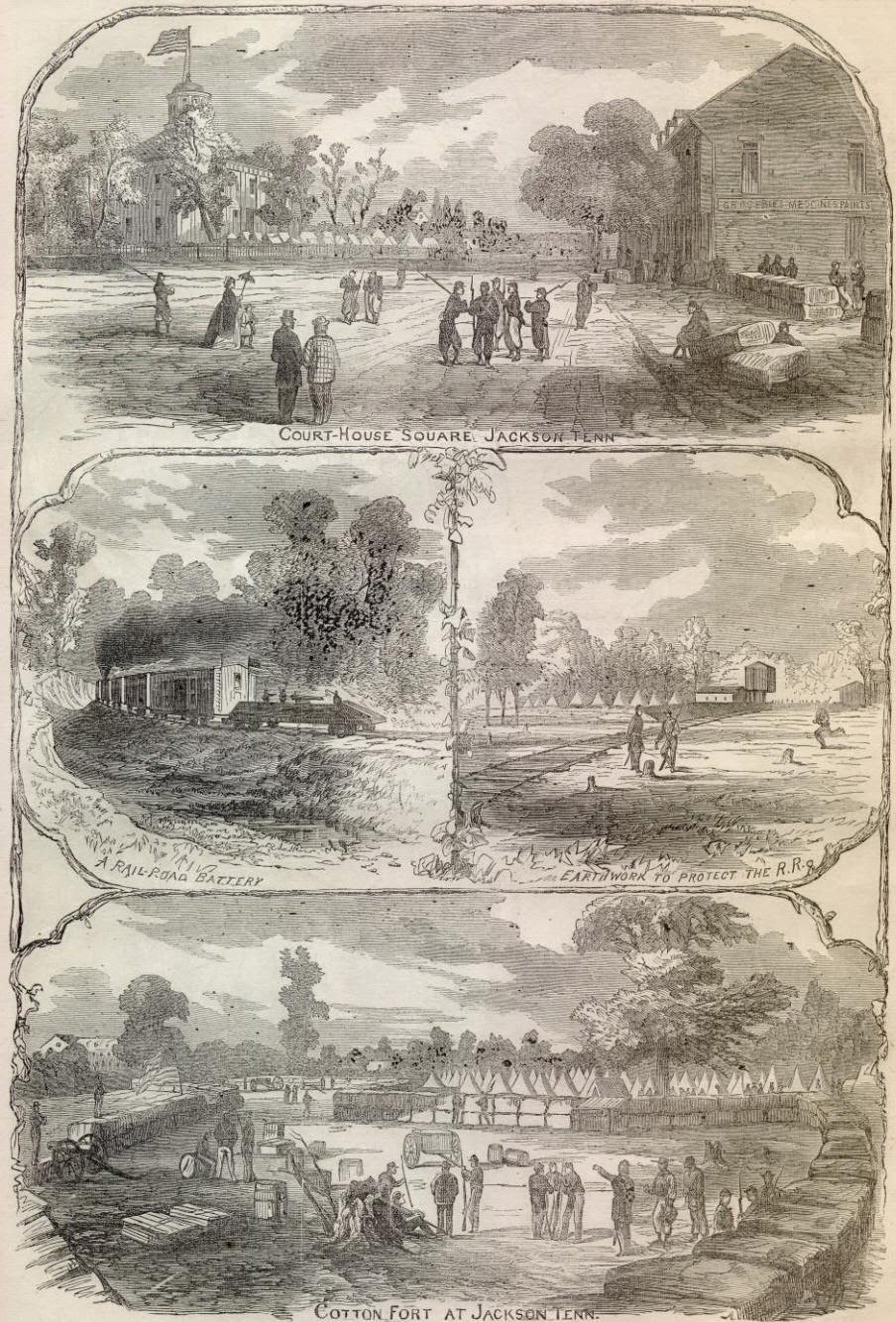
Tennessee was seen by the Union as a strategic target because of its
position as the uppermost Confederate state on the western side. Only in
Virginia were more actual battles fought during the War; Tennessee land endured
over 2,900 battles and skirmishes with over 122,000 soldiers on both sides
dying in combat within the state. Tennessee was the last state to leave the
Union, and it was the first to be controlled by Union troops once the war
began.
![]() |
| Lithograph from Harper’s Weekly, Fall 1862 |
The Whittentons lived outside of the city of Jackson on the southeast.
Jackson had early on been taken over by Union troops who stayed in the city to keep
it against the Confederates. But Confederate General Nathan Bedford Forrest in
December 1862 decided he had to stop General Ulysses S. Grant’s progress down
the Mississippi River, and to do that, he took his 2100 cavalry troops across
the Tennessee River just north of Jackson on his way to Memphis to destroy a
Union supply depot. On the way past Jackson, some of Forrest’s troops engaged
with a few Union soldiers as a sort of distraction while the rest of his force
destroyed the railroad tracks both north and south of the town. Then they
withdrew and went on to Memphis. That was the sum total of the Battle of
Jackson, in which six lives were lost.
The other battle close to the Whittentons was that of Parker’s
Crossroads, over the county border in Henderson County and a little north of
Jackson, which occurred when General Nathan Bedford Forrest was returning east
with 1800 troops from Memphis. Two brigades of the Union Army of about 3000
soldiers surrounded Forrest’s cavalry at Parker’s Crossroads, before they could
get to the Tennessee River. General Forrest ordered his army to split in two
and charge both sides at once. They succeeded in forcing the Union troops to
retreat, but at a cost of 500 of their own men, while the Union brigades
suffered more than 200 casualties.
One of the worst battles of the war fought in Tennessee was the
Battle of Shiloh, in Hardin County southeast of Madison County. To get to
Shiloh in March 1862, the Confederate army under Gen. Beauregard moved
southward to the west of the Whittenton lands and took the rail lines down to
Shiloh. The Union army went down the Tennessee River to the east of the
Whittenton lands, and the battle raged over two days in April of that year. It
was an incredibly bloody battle, with over 13,000 Union soldiers and over
10,000 Confederate soldiers killed, but it was only a precursor to the three
years of ferocious fighting left in the war. It resulted in a Union victory and
allowed the Union army to capture Memphis right afterward. Gen. Ulysses S.
Grant continued down the Mississippi River to Vicksburg, cut the South in half,
and gained control over the Mississippi River. The Confederates lost General
Albert Sydney Johnston, up to that time the leading general in the entire
Confederate Army, at Shiloh.
![]() |
| Map of 1862 Western Theater, by Hal Jespersen, www.cwmaps.com |
Tennessee was the site of one of the great Confederate victories,
which happened in November 1864 under General Nathan Bedford Forrest, when he
commanded his troops to destroy the Union naval depot at Johnsonville on the Tennessee
River. Despite being a significant military coup, it was not instrumental in
changing the tide of the losing battle the Confederates were waging.
All these battles within the state and with soldiers close to their own
homes would have made the Whittentons very concerned about the war and its
progress. Their state was under martial law and early in the war was turned
over to their own Senator Andrew Johnson, who was the only Southern politician
to remain in the United States Congress, and so President Lincoln appointed him
the military governor of Tennessee when the Union Army gained control of its
capitol.
Life was disrupted in many ways during the War. Slaves of course were
set free, and although their freedom wasn’t official until the war was over,
they mostly stopped working for the white masters, and the white men and women
had to work in the fields as much as they could, even using little children to
do adult chores to have enough food. Trade was disrupted, inflation soared, and
deprivation was everywhere, even if their animals and food supplies were not
seized outright by the occupying troops. There were many conflicts between the
white southerners and the former slaves over how and where the newly-freed
people would set up their homes, churches, and schools, and how their new labor
contracts would be negotiated. All of these issues would be faced to some degree
by the Whittenton family, if not during the war, then certainly during the
Reconstruction period afterward. One effect of the war seems to be that Solomon
came out of it poorer than he went into it, which is not at all surprising for
the area, as Tennessee had been hard hit by economic problems due to the war.
Reconstruction in Tennessee was not as hard in some ways as it was in
the rest of the former Confederate states, partly because Tennessee lost no
time in rejoining the Union in 1866. The rest of the South was placed under
federal military control. But the people of Tennessee had to struggle to learn
how to work with one another, especially how to get black and white people to
work together as free and equal citizens. Tennessee was the first Confederate
state to give all African American men the right to vote, but the first
election caused great conflict because many former Confederate white men were
not allowed to vote. Many of the newly free black men voted for radical
Republican measures, and nearly all the formerly Confederate white men wanted
to vote for conservative Democrats. During Reconstruction, the radical
Republicans won the first election and passed lots of controversial new laws,
some of which were reversed when the Democrats regained power.
![]() |
| Early 1866, Central Tennessee |
An
uncomfortable fact was that the Ku Klux Klan got its start over in Pulaski,
Giles County, near the middle of the southern border of the state. The Klan
started as a social club for young white men, but within about a year it turned
to violence against African Americans, radical Republicans, and former Union
sympathizers. Separate dens spread quickly throughout Tennessee, with pockets
all around Madison County being especially active. Former Confederate General
Nathan Bedford Forrest was appointed the Grand Wizard of the Klan in Tennessee.
Governer William Brownlow declared martial law against Klan violence, including
in Madison County. Brownlow left office. In 1869 Forrest called for all
Klansmen to destroy their robes and disband, believing they had fulfilled their
purpose in driving away the hated Republican. It is
unfortunately reasonable to suppose that the Whittentons sympathized with the
views of the Klan and its leadership. Tennessee people had a difficult time
accepting the social changes.
Researcher Diane Bollert with the website “Too Many Branches” found
that Solomon was listed as a member of a church in Jackson, Madison, Tennessee,
as of August 1869. Presumably this was the Primitive Baptist Church, but the
record is not available to us. This is an interesting tidbit to add to the
picture of Solomon’s character. Perhaps he felt the need for some kind of
settled spiritual or religious connection. At this time he would have been 56
years old and his wife almost 50. Their daughter Valerie was 18, William (if he
were still living) was 16, Mary Ann was 15, Frances was 14, Mary Jane 12, Jos
Laney was about 9 (if she were living), Jabe was almost 8, and Bedford was 5.
It could be that William and Jos Laney had died, and their deaths stirred up a
need in the family to look to matters of eternal significance. The two children
died after September 1860 and before November 1874.
In 1870 the county census taker for the agricultural schedule came to
the farm and found Solomon doing well, but with only half the land he had owned
ten years before. In 1870 he had only 50 acres of land, of which 25 were under
cultivation yielding 250 bushels of Indian corn, and 25 were woodland. The
value of his farm was $800, and Solomon had paid out $50 in wages to his
workers. His livestock, worth $800, consisted of three horses, two mules or asses, one milk
cow, three other cattle, eight sheep,
and twelve pigs. Inflation had hit, and although Solomon’s farm was half
what it was in 1860, it was valued at more.
Curiously, the 1870 population schedule, taken by the same assistant
marshall, recorded a completely fictitious family under the name of “S.
Whittington.” Perhaps he had forgotten to make notes on the family after
getting all the agricultural information, and rather than return to the farm a
second time, he made up the information from what he could remember.
Solomon’s death was reported 8 December 1874 to the county court as
follows: “Solomon Whittenton died about November 2, 1874; left wife and six
children.” He was 61 years old.
The map below
shows District 17 in Madison County in 1877, with the farm of Mrs. M.A.
Whitenton, Solomon’s widow, right next door to the widow of Solomon’s father,
Mrs. K. Whitenton. Rocky Springs to the immediate southwest was where many of
the Whittentons were buried. Mrs. B. Whitenton to the northeast was probably Solomon’s
brother George’s widow, Martha Elizabeth, whose nickname perhaps was Betsy.
Mary and her children were recorded in the 1880 Census on June 7th.
She said she had been born in North Carolina and was 54 years old, although she
was probably older. The box for being unable to write is checked, so probably she
had very little schooling and was not able to be accurate with dates and ages. Her
daughter “M.A.” (Mary Ann) was with her and was recorded as 23 years old, but
she was actually about 26. Her sons Thomas J and Bedford F were also there,
working as laborers. They were reported to be 19 and 16 years old,
respectively, although Thomas Jabe did not actually turn 19 for another three
months. Mary died 20 December 1886, at the age of about 65. Her children Mary
Ann and Bedford Forrest died between 1880 and November 1887.
Only four of the
children of Solomon and Mary grew up to marry and have children of their own:
- Valerie Jane married James Hart and had four children.
- Mary Jane married first Barney Johnson and had two daughters. After Barney’s death, she married William Lester Munro and had nine more children.
- Frances Elizabeth married George Darling Pond and had five children, only one of whom lived to adulthood.
- Thomas Jabe married a younger sister of George D. Pond, Narcissus Jane Pond, and they had eight children.
Wednesday, February 18, 2015
I’m Too Tired to Do My Job, So I’ll Just Invent the Report
All genealogists know that census records are to be used
with caution. Sometimes the records are golden and give corroboration to every
other record out there. But sometimes they are amazingly wrong. Astoundingly
wrong.
In District 17 of Madison County, Tennessee, the three
Whitenton brothers (also spelled Whittington
or Whittenton) were George, Solomon,
and Othaneil, and their farms were bordered by neighbors who had, like them,
been in place for several decades when the U.S. Federal Census of 1860 was
taken. They were counted by an enumerator who came around to their farms, spoke
to someone supposedly responsible, and listed on a form with each person’s
name, age, gender, birthplace, and sometimes occupation written out. The 1860
forms show these families in detail that matches all the family information and
other records we have on them. The 1860 census is the golden one.
The 1850 and 1880 censuses are also extremely helpful in
proving the picture of these families.
But in 1870 the census taker in District 17 of Madison
County, Tennessee was too lazy to get out and actually talk to the people he
was supposed to be enumerating. Either that or all three Whittington families
unaccountably were away from their farms in mid-June (highly unlikely) and the
enumerator talked to the neighbors, or he was a Yankee sympathizer who was afraid to go out to those staunchly Rebel families and instead simply said, “Aw, them Whittintons,
they got passels o’ chillen on down the line, all of ‘em.” And then he made it
all up.
Whatever happened, he definitely was inventive. For example,
George’s family was headed by his widow, Martha Elizabeth, because George had
died in 1867. The census taker, seeing “M. Whittington” as the head of the
family on the list of families to contact, decided that this must be the man of
the house and invented a wife two years younger, and then some logically spaced
children for the household. And so on.
Here are the lists of actual household members and the
census taker’s invented data:
George.
Martha Eliz.
|
44
|
F
|
M Whittington
|
42
|
M
|
|
LJ Whittington
|
40
|
F
|
||||
James M
|
(married and gone)
|
|||||
Mary Frances
|
(married and gone)
|
|||||
Thadeus Erastus
|
20
|
M
|
Wm. Whittington
|
19
|
M
|
|
Coley Horace
|
18
|
M
|
Wash. Whittington
|
18
|
M
|
|
Lucius Edward
|
17
|
M
|
A. Whittington
|
16
|
M
|
|
Jennie Elizabeth
|
14
|
F
|
N. Whittington
|
15
|
F
|
|
George Quintilian
|
12
|
M
|
F. Whittington
|
14
|
F
|
|
Wm Louis Yancy
|
8
|
M
|
T. Whittington
|
13
|
F
|
|
Robert Lee
|
6
|
M
|
F. Whittington
|
12
|
F
|
|
Alethia P Ann
|
4
|
F
|
N. Whittington
|
10
|
M
|
|
Solomon.
Solomon Y
|
57
|
M
|
S. Whittington
|
41
|
M
|
|
Mary A
|
50
|
F
|
N. Whittington
|
39
|
F
|
|
Valerie Jane
|
19
|
F
|
||||
William
|
17
|
M
|
E. Whittington
|
16
|
F
|
|
Mary Ann
|
16
|
F
|
A. Whittington
|
14
|
M
|
|
Frances Elizabeth
|
15
|
F
|
T. Whittington
|
13
|
M
|
|
Mary Jane
|
13
|
F
|
S. Whittington
|
12
|
F
|
|
Jos Laney
|
10
|
F
|
J. Whittington
|
10
|
M
|
|
Thomas Jabe
|
8
|
M
|
B. Whittington
|
8
|
M
|
|
Bedford Forrest
|
6
|
M
|
L. Whittington
|
4
|
F
|
Othaneil.
Othnell
|
55
|
M
|
O.W. Whittington
|
48
|
M
|
|
Christina R
|
36
|
F
|
L. Whittington
|
43
|
F
|
|
James Arthur
|
12
|
M
|
E. Whittington
|
18
|
F
|
|
Martha Ellen
|
8
|
F
|
A. Whittington
|
16
|
M
|
|
Frances E
|
5
|
F
|
J. Whittington
|
15
|
M
|
|
D. Whittington
|
13
|
F
|
||||
N. Whittington
|
9
|
F
|
*****
Source:
1870 United States Federal Census; District 17, Madison, Tennessee; NARA Roll: M593_1545; Pages: 375A, 375B, 384A, 384B; Images: 757, 758, 775, 776; Family History Library Film: 553044.
Ancestry.com. 1870 United States Federal Census [database on-line]. Provo, UT, USA: Ancestry.com
Subscribe to:
Posts (Atom)